

Nice, Cute, and Wrong: The Real Story of Sustainable Fashion
The co-founder who sold Adore Me to Victoria's Secret takes apart a few comfortable assumptions about what sustainable fashion is actually solving for.
Featuring Romain Liot | Co-founder of Adore Me, author of Reset Fashion

About this episode
Romain Liot co-founded the lingerie brand Adore Me, scaled it across the US, and sold it to Victoria's Secret in 2023. In the years since, he's turned his attention to a harder question: what is "sustainable fashion" actually solving for? In this conversation he pushes back on a few comfortable assumptions: that shoppers will pay a real premium for sustainability (his data says about 3%, not 25%), that beige and pastel palettes signal anything meaningful (there's no correlation between a garment's color and its carbon footprint), and that brands chasing scope 1 emissions are making real progress, when 98% of fashion's footprint actually sits in scope 3. Dyeing and coloring alone account for roughly half of that footprint — two to three times the emissions of the entire airline industry. Romain's argument, laid out further in his book Reset Fashion, is that no single actor, brand, government, or shopper, can fix any of this alone.
The conversation

Quickly, think of a sustainable fashion brand, any that comes to your mind. Does it include earthy tones or linen? Is it a brand with a nice origin story and a slightly higher price tag to prove it means business? If yes, then that's exactly the version of sustainable fashion that looks really good on a mood board. And for a long time, I think a lot of us, me included, accepted that version without asking too many questions. But what if most of what we think we know about sustainable fashion is well-intended, beautifully packaged and kind of wrong?
Today, I'm talking to an entrepreneur who built a lingerie brand called Adore Me from scratch, scaled it across the US and sold it to Victoria's Secret in 2023. After a decade inside the fashion machine, he stepped back, looked at the sustainability conversation happening in the industry and decided it needed a reality check. So he wrote a book called Reset Fashion.

What we talk about in this episode is more than what I expected. For example, there is a statistic he shares about dyeing, which is the coloring of fabric, that is going to make you rethink everything you thought you knew about fashion's carbon footprint. I'm not going to tell you now, but when you hear it, you will know. Let's go.
Hi, I'm Tori, and welcome to Curious by Design. This is a podcast about the hidden systems behind everyday things, the quiet decisions, the invisible chains, the stories nobody tells you, but that shape your life more than you think. This season, we are pulling on one thread. Fashion. Not trends, not aesthetics, the real stuff. Materials, labor, power, and what it actually costs to get dressed in the morning. Beyond the price tag. So, let's get into it.
So Romain, before we get into the hard stuff, I want to know who you are. Take me through your path, what you've built, where you are now, the whole thing.
So I'm Romain. I'm an entrepreneur in fashion. I'm a father of two children. My professional journey started in consulting at McKinsey. Then I co-founded a fashion brand in the US. It was called Adore Me. Like every entrepreneur adventure, we had a lot of ups and downs, but the story finished well, at least for me, as we sold the company to Victoria's Secret in 2023. And since then, I've been spending my time on different aspects of fashion, sustainability in fashion, because there are so many things to do, so many opportunities and so little time. So that's what I'm doing now, working at the crossing of sustainability, fashion and innovation.
Okay, I love that. From McKinsey to lingerie, not a sentence you hear every day. What actually made you start the company? Was fashion always the plan?
It was a little bit unexpected. I mean, I met my partner at McKinsey and he wanted to launch a business. He started the first business in the US that didn't work out and he pivoted for something else. And he was enthusiastic about the future of fashion being in e-commerce. So that was back in 2012. And it made me join the adventure. But, you know, life takes you in an unexpected turn. I mean, I was 32-33, selling lingerie in the US. It was not my career plan. So that's a little bit random. But then what the plan was, was to launch a business.
I think there was an entrepreneurship adventure and using technology to make things a bit different. Technology in fashion back in 2013 meant having a dot-com. So it was not AI or things like that, but still there was, like, what are the opportunities of technology to serve and address a market in a different way. And then, making things simplified, it was the beginning of social media, they were doing advertising and so on. So there were many pieces of technology that were added and have changed, with pros and cons, the way fashion is operating today versus how it was operating even 10 years ago.
I love the story. And the fact that it worked. So what actually makes a brand successful? Because obviously there are brilliant people with brilliant ideas who never got there. So what was the combination for you?
I mean, what makes a brand successful? I think that first, in every entrepreneurial adventure, there is a big part of luck, that we should not underestimate. I met so many entrepreneurs that were brilliant, worked very hard, and had great ideas, and the timing to market was not the right one. So I think that it's important to acknowledge that chance is a part of any adventure. And of course, you can increase the odds by being smart, by working hard, by analyzing the market, but there is still this factor.
I think that we had a good analysis of the market on what we guessed, which was that e-commerce would hit the world, and our price point. We were targeting to sell a product between $40 and $80. And why this target? Because below $40, we figured out it was not possible to compete against Amazon or a really cheap product. And above $80, nobody would buy a product above $80 on the internet back then. So we were like, okay, what can we sell in this $40 to $80 range? That turned out to be good strategic foresight.
The other thing is, we noticed there was a segment in lingerie where the price of the product and the experience online was not amazing. And paradoxically, lingerie has a long history of selling at a distance. If you look at 100 years ago, before the internet, at the Sears catalogue, which was distance commerce 100 years ago, one of the most successful categories was intimate apparel. That means it's a category that might be easier because there's a relationship with the customer, she wants to try it, there's a bit of intimacy and so on. So it was not totally unknown ground to shop at a distance.
And then there were all the things we didn't know back then that turned out to be part of the success in retrospect. Facebook was starting to do advertising, and in 2013 it was really a revolution, because suddenly any small brand could have access to this great tool of targeting that didn't exist before. We're used to that now, and Facebook prices have gone through the roof. But back then it was relatively cheap. It was very rudimentary compared to what we have today, but it worked, and the most important thing was: you show an ad to somebody, a semi-qualified customer was there. "I want to display my ad to a woman interested in fashion in the US, and I'll pay one dollar per click," and you would get this. That was new, and for us it was a big factor in reaching a certain level of growth and unlocking new opportunities.
And there were also things we didn't know, like that the lingerie market was extremely hard. It's a bad market, don't open a business in lingerie. Within fashion, it's a small subset, less than 10%. And the product has a lot of complexity, more than a shirt. If you look at my shirt, it has maybe eight components. If you look at a bra, it has more than 50 components. And that has implications for the supply chain, for the suppliers you work with. So that's one aspect.
And you also have all the sizing, which is very specific. You have to offer more than 40 sizes to be inclusive in the US, versus a shirt, which is more like 10 sizes max. And this sizing has consequences in terms of designing the product, but also in terms of inventory, MOQ, and so on. So it requires a lot of cash. The lingerie market, for all those reasons, is a bit atypical and pretty complex. And I think for us, in retrospect, it was our chance, because we were geeks, coding, crunching data, using what we learned at McKinsey. We were well equipped for that. If we had decided to launch a cool brand selling shirts, where the coolness factor would be more important than the quantitative factor, I don't think I would have been successful. We don't know, but let's say this complexity turned out to be an advantage for us, based on the profile we had.
Okay, so your weakness became your strength. The thing that made it harder for everyone else made it easier for the two of you specifically. That's kind of a beautiful lesson, actually. And you launched in the US. Was that always the plan?
No, and it's always a mix of reasons. The US market is huge, let's be honest, it's giant. There's a lot of consumption. It's less fragmented than Europe. And you have a habit of shopping online, and shopping in general, that is very strong. So I think we had a natural advantage. And I think the competition might also be lower in this space than in Europe — in Europe, every country has a few lingerie brands with their own particularities. So here, suddenly, you have access to a big pool.
You built this before Shopify was the default, before TikTok existed, before AI was a word people used at dinner parties. So if you were starting the same company today, exact same company, same idea, same you, how different would the journey be?
It's a good question. I think it will be an answer that sounds like a little bit bullshit, but I think it has some pros and cons. Well, clearly, if I was to launch it now, let's say I have more experience and I've learned a few pitfalls, so I will try to avoid those pitfalls. I think the market might be more mature as well in terms of e-commerce adoption. But there is some good stuff happening now too. You have Shopify, for instance, which is a revolution for e-commerce. We had no Shopify back then, it was Magento, an old version of Magento, and I can tell you it was, let's say, rudimentary. So now the universe of apps built on Shopify that manage a lot of things, it's a game changer. Instead of having to recruit 20 or 30 tech developers to get a cool website up and running, you can almost do it alone or with one developer. So I think that's changed, because it reduced the cost of entry to launch a brand. So that's on the positive side, if I were to launch such a business today.
On the challenging side, I think there's more competition now, because it's easier to launch a brand as well. And I think the biggest challenge for me would be the price of ads. Facebook prices were way cheaper back then — in 10 years they've multiplied by 30. That changed the economics of e-commerce and fashion entirely, not only fashion, but every business that wants to advertise. But I'd say fashion is more impacted, because the margins are pretty thin. So the price of advertising is different. I'm sure there are new channels that are interesting, new opportunities — and let's be honest, I might be a bit rusty now, because I'm less into this. Cool stuff is happening, TikTok Shop might offer some new opportunities for virality that didn't exist before. But clearly, the marketing cost of entry is different, and might be more difficult today than back then.
After you sold Adore Me, you could have done anything. You could have retired, or launched something completely different, or just advised startups and kept it low key. What made you go specifically into sustainability? Because it's not an easy space. It's messy, it's political, and honestly, the results are slow. Why here?
In fact, I'm still in the fashion space, but in a different way. I left Adore Me in 2024. The company is still operating, and pretty successful, under the wing of Victoria's Secret. I'm not involved at all with Adore Me anymore. I'm doing different things in the fashion space, advising different startups that are pushing the sustainability objective. I just released a book called Reset Fashion, where I try to explain the challenges and pitfalls of sustainability in fashion, and the opportunities as well. So I'm still active in the fashion space, but the fashion space is so large — I'm just doing something else now. I'm not selling product for a brand, I'm trying to help businesses be successful in this space, in a role that's more support than front line. So it's different.
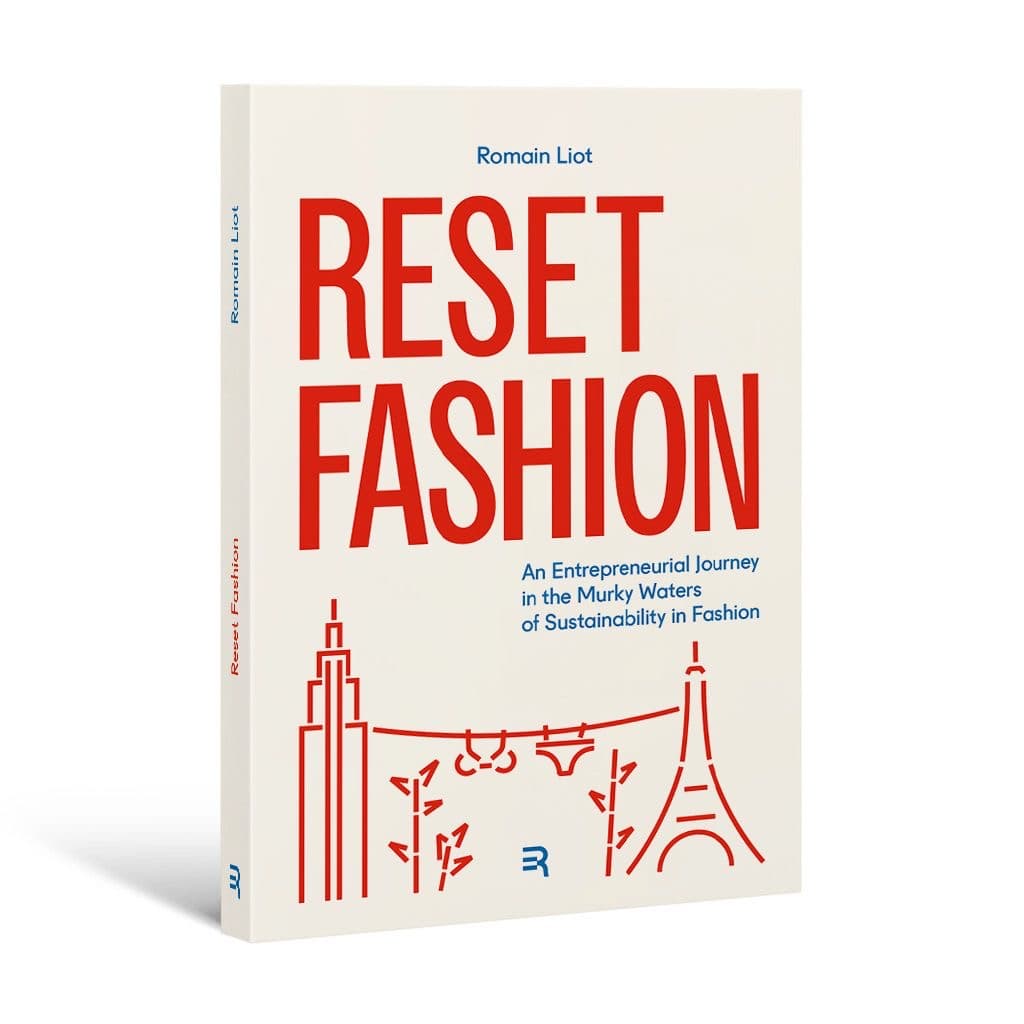
And the book. What pushed you to actually write it? Because writing a book is a very specific kind of decision. It's not a LinkedIn post. So what made you say this needs 350 pages?
Great question. It's a combination of factors. First, I've always been super willing to share what we were doing. I think that was the DNA of Adore Me — we were participating in conferences, sharing what we were doing. We had this open source culture. Every year I was publishing a big post on a blog to explain the challenges we had and so on. So we had this culture of sharing.
Second, I think there are so many things to do that it's worth having a good collaboration mindset and working as a team.
And last but not least, I'm a bit disappointed, let's say, by the direction of sustainability within the fashion space. And I think a lot of the stories we hear are just not correct. I mean, they are nice, they are cute, they are wrong. So I had to write my own story and my own narrative to explain how the landscape truly is, and what should be done, in my opinion. It's a complex topic, so it requires some depth. And I think the book was a good format for that, because you have 350 pages of analysis on the fashion space, which I think are needed to really help people understand the landscape, the pitfalls, why things aren't working. And of course, in 350 pages, you can say more than in a tweet.
Okay: "nice, cute and wrong". I need you to be specific. Give me examples. What are the stories we are telling ourselves about sustainable fashion that just don't hold up?
Yeah, sure. I think in general there's a theory of organizations that's very interesting. It's called the unintended consequence of good intentions. It's a theory that dates from the 60s, I believe. And basically it explains that you can have good intentions in a complex ecosystem, and it doesn't translate into a good outcome, because there are many effects, a lot of stakeholders, unexpected turns and so on. Think of Airbnb — when it launched, it was a nice project, you rent your room to make extra money. And now you go to Barcelona and it's full of Airbnbs, and the locals aren't very happy about the perks that were offered by Airbnb. It's a good example of good intent but a challenging outcome.
This actually connects directly to something I heard in episode 3. Nathalie from Carla Vorarlberg told me they regularly receive brand new, unworn Shein shirts in their donation containers — still in the color range, zero stains, zero quality. So the product exists, the transaction happened, the carbon was emitted, and it ends up in a sorting plant.
And in the fashion space, there are a lot of examples of good intent but bad outcome in the end. For instance, there's the belief that customers will buy more and more sustainable fashion, which people wanted to believe, but in fact it doesn't really materialize. So a lot of businesses weren't successful, and a lot of strategic directions taken weren't the right ones, because it has implications. People say, okay, but customers will buy more, let's invest more, let's increase the price of the product. And in fact, there is no green premium, or it's a very minor one. So that was the wrong direction.
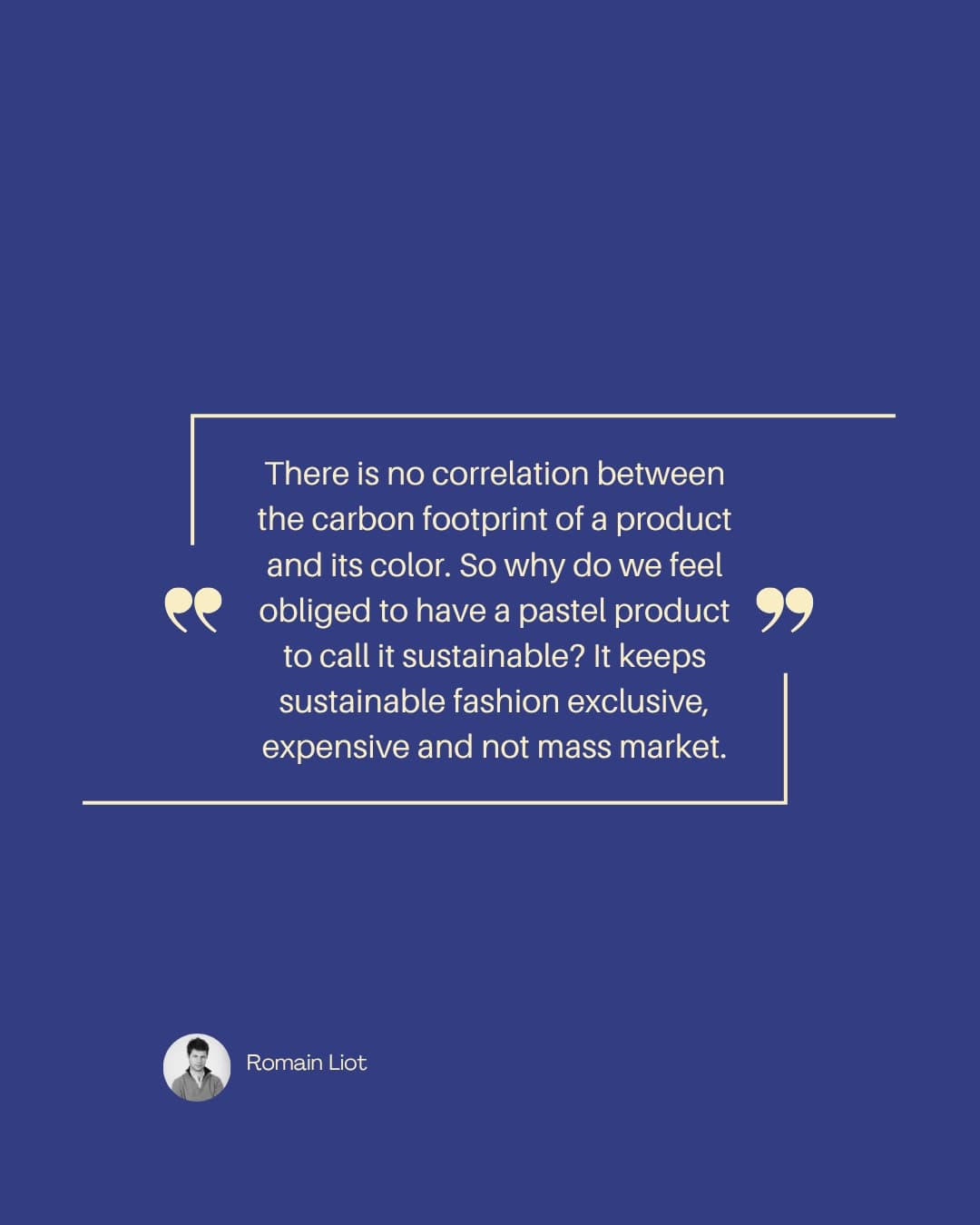
Another example: the aesthetic of sustainable fashion. The color code of sustainable fashion is very beige-toned, pastel, and so on, which is an elegant mood-board story material for sustainable fashion. It looks a bit Nordic. But in fact, it's not a good direction, for a simple reason: most customers don't like those colors. In the US, the top five colors are red, blue, yellow, pink, and energetic green. So if you propose a beige product, sorry, it doesn't work. And there is no correlation between the carbon footprint of a product and the color of the product. So why do we feel obliged to have a pastel product to say it's sustainable? It's just a construction, and it's wrong, and it's an issue, because it leads in a direction where sustainable fashion is exclusive, expensive, a bit luxury, and not mass market fashion. And the challenge is to mainstream sustainability, not keep sustainable product in a niche of luxury. So that's an example of good intent but bad outcome. And there are different examples of such pitfalls in sustainable fashion, and what should be done about that.
Hold on. I want to make sure I understand the beige thing. Are you saying that brands are choosing those colors because they genuinely believe it signals something? Or that customers started expecting it? Like, who started that?
It's a chicken and egg. I think it started with fashion brands pushing an aesthetic that was this way, based on the mood board and also the process of fashion. So now it's true that a lot of customers associate sustainable fashion with that aesthetic, and some are happy with that, and some aren't. And now the point is, it's there, but it's worth questioning this aesthetic, because it's designed to stay a minority of fashion. It's not neutral. We were a mass market brand, selling all across America, and let's be honest, the average consumer is not a big sustainability fan. That doesn't mean they don't like it, it's just that they'll buy a product because it's nice. So if we were to do a category of sustainable product that wears this color, you cap your potential at 10% of yourself, while I think we should hope to have 100% of sales be sustainable product. So that's an example. The process was more that brands pushed with a lot of marketing and campaigns, and now customers associate with that — but it's not really the right direction.
So if the beige world is a trap and customers aren't willing to pay a big premium, how do we actually make sustainable fashion work at scale? What does that bridge look like between where we are and where we need to be?
There's a lot in your question. I didn't say customers don't care — they do care, but they tend to accept a premium of around 3% on price. So you need to have more or less the same characteristics of the product, in terms of experience — not exactly the same, but more or less — and the product being more sustainable. That's not easy, but it's feasible. But if you come with a product that's 25% more expensive, people won't buy it. And it's not that people are villains, it's just that they're human, they have their own constraints. So I think it's the role of business to come up with a more sustainable product in this price range. So how do you do it?
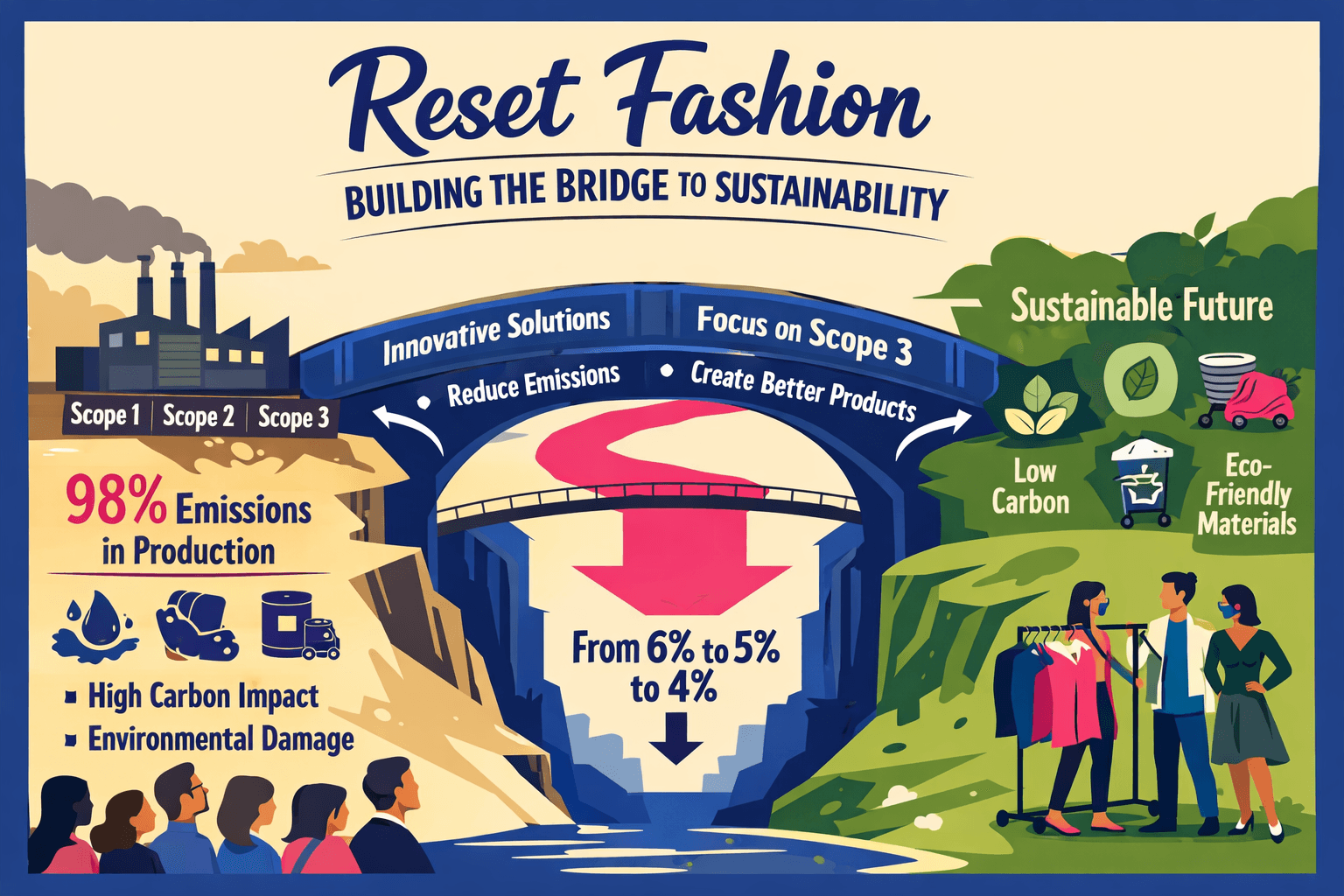
There's a lot to be done. It's not a magic formula, an envelope you open and things go where you want. If you read the book, there are examples. But it's many, many factors. There's work to be done on focusing on the right battle. Focusing on the right battle typically means focusing on where the carbon emissions are, which are typically on the production side. We call it the scope of fashion — scope one, scope two, scope three — that's a way to compute where the source of your product's carbon emissions is. Is it a direct emission of your business? That's scope one. Or is it indirect, more on the production side? And that's not specific to fashion, you can do it for any sector. Some businesses, like airlines or construction, have scope one, direct emissions, at 60% or 70% of their carbon emissions. So they work on scope one, because it makes sense. In the case of fashion, 98% of the emissions are happening in scope three, indirect. And most of the effort of fashion brands is focused on scope one, the 2%. Why? Because it's easier, they control it. But I think it's the wrong direction. I think most of a company's effort should be focused on scope three.
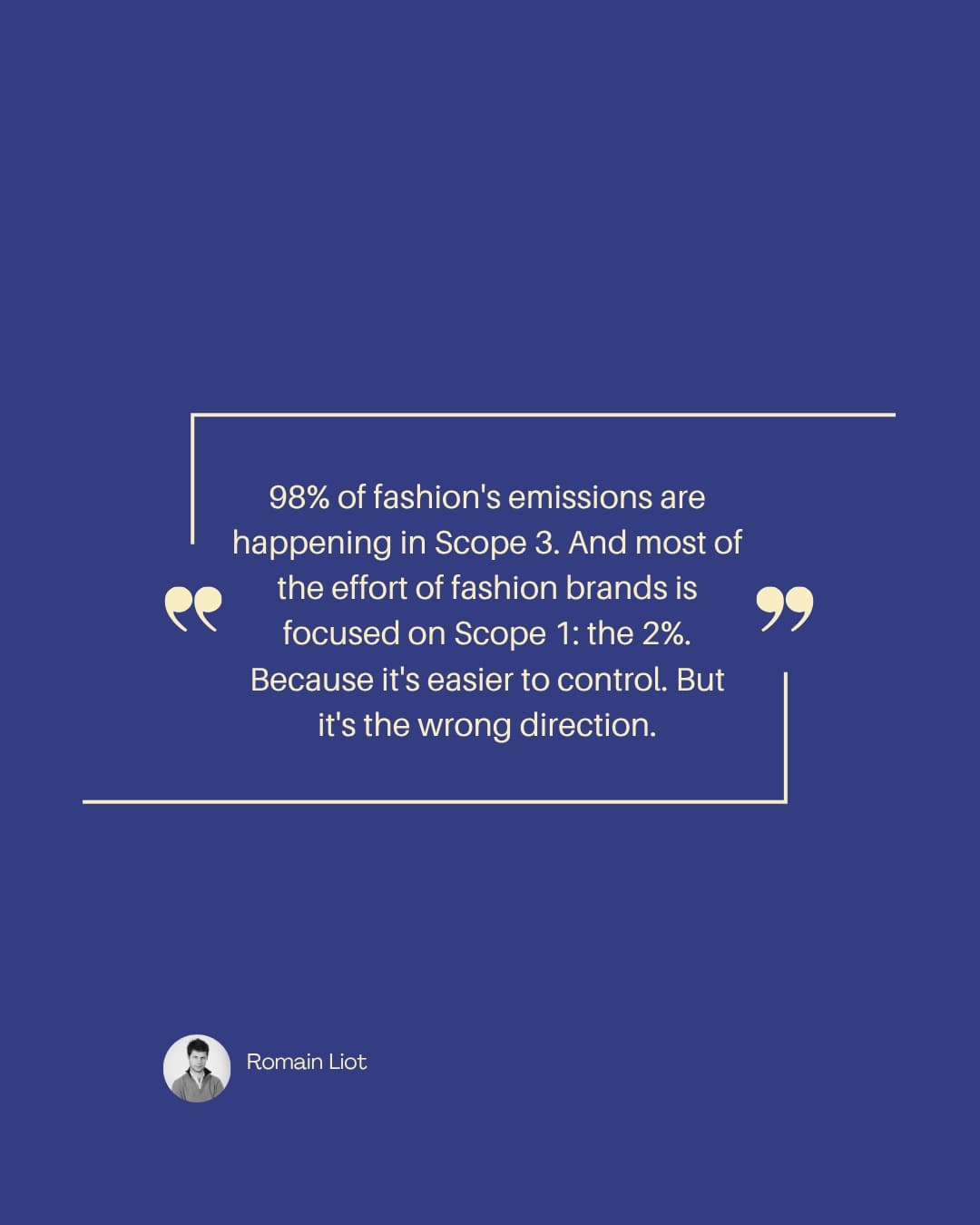
What do we do about that? It requires a change of mindset. It requires awareness. It requires solutions. But at least let's work on where things are truly happening, instead of bragging about an initiative to turn off the electricity in the headquarters or in the retail store. It's epsilon. If all the fashion brands turned off the lights at night — or turned them on at night — it would be epsilon. So don't communicate about that, please, because it's just a way to fool people, customers, but also people inside the company. It's not really an initiative that matters.
Epsilon. I love that word for it. Like, technically true, completely irrelevant.
So that's focusing on the right battle. Then, within the right battle, the key is to provide products that are better. Better can have a lot of definitions — it can be less carbon, less water usage, less chemical use, less impact on biodiversity, and so on. So it's not easy, and it can become very technical quickly. Let's be honest, my goal is not to get into a battle over whether we should favor biodiversity or carbon or whatever. I think it depends per product, per brand, but at least a better product is a good direction.
Because the fashion industry today is 6% to 8% of the carbon emissions of the planet. That's massive. And unlike a few other industries that have at least started reducing their emissions, fashion's are still going up every year. Not a little — every year it goes up. So if we could at least move in the right direction, go from, let's say, 6% to 5% in two years, then 4%, then 3%, I would totally sign up for that. And I'd rather agree on the direction and staff for it than have a specialist debate about whether biodiversity matters more than water usage. Both matter, but at least let's move on the right topic.
Something I keep bumping into in these conversations is that nobody defines sustainability the same way. For some people, it's materials. For others, it's labor rights. For others, it's carbon. How should we, as consumers and as brands, decide what to care about and what direction to go?
It's a great question, and I think it's part of the challenge. You have different bodies that have tried to come up with a definition — the Global Fashion Agenda, the United Nations, with a framework, and other very smart people who've been thinking about it. All the definitions are correct by design, but you're right that sometimes they overlap, sometimes they're different, and it's not easy. Some are more focused on the environmental aspect, others have a bigger social component, with the right to labor. And I think that's part of the challenge, because it's become a bit of an open house, where everybody can claim they're doing something good for the planet without really agreeing on what's inside that claim.
I think this diversity of definitions is sometimes a trap, because it can hide a bit of bullshit. It's also an opportunity, a kind of pluralism of positive impact. And I think it also depends on individuals, what their preferences are, and also on the brands. If you have a brand that communicates a lot about ocean protection, naturally there will be more water-protection folks around it than labor-rights folks. Some will say, no, we try to touch on all aspects with some kind of complex mental construction, and they'll be right about that too. Others might focus more on 'no chemicals is good for your health.' So I think it depends.
Personally, I prefer the word 'systemity' to sustainability, because systemity is at least about the environment, climate warming, biodiversity. But that's my personal preference. Some people say, no, for me, labor rights matter more, and I want transparency. I think what's common to all these elements is: the more transparency, the more information people have, the better the choice. When you don't know how your garment is made, it can have a bad effect on biodiversity, labor rights, or chemical usage, and if you don't know anything, there's not much you can do. The day you start to have this transparency, you might be a bit more selective in what you choose. And that applies to individual customers, but also to brands. I'm not sure that fully answers the question the way you wanted, but that's my view on this diversity of definitions of sustainable fashion.
That brings me to a question I've been sitting with for a while. Because everybody talks about this. Consumers, brands, governments. And somehow, nobody seems to feel truly responsible. It's always the other person's problem. So, honestly, whose job is it?
Yeah, I think, first, the world is not binary in general, and especially when it comes to shared responsibility. Everybody can find reasons to say it's not my fault, for sure. But in fact, it's much more diffuse — let's call it shared responsibility. What's for sure is that everybody will pay the consequence and the price of a bad outcome. It will be you, it will be your children, and the children of the brand owner, the children of the politicians, the children of the NGO people. We could argue about who should do what, but the outcome will be widely shared by everybody. Maybe some countries will suffer more than others, but it will be bad for everybody. So I prefer to ask who has the power to steer things in the right direction. And everybody has their own kind of secret power.
And it's not easy, because there are a lot of different stakeholders, sometimes with competing interests, but everybody has their secret power. Typically, to make things much simpler than they are, you have four constituents.
You have the government, which can try to influence things through new regulation and so on. That's good, because you need systemic change, you need to raise the bar. But they can't do anything alone, because if there's no other constituent following up, they can write a law and nothing moves. That's a little bit what's happening. So they have the power of prescription, but not the power to actually do. They need others to act.
Then you have the brands, the businesses. They actually have a lot of responsibility, because they could literally wash their hands of it and think, oh, it's only up to consumers. But that's not true, because they hold the wallet, so to speak, and they also hold the competencies. Most of the competencies are still inside existing businesses, with smart people, engineers, people placing POs, and so on. So it's not something that's easy or trivial for them to give up. They have a lot of power to act. They can also think, so they have some prescriptive power too, but they have this superpower of actually doing things. And it's also in their interest, because the status quo isn't stable. If you wash your hands of your responsibility, I can tell you in five years, in ten years, you will disappear. Think of a good analogy: Blockbuster, which used to run video rental. Back in the day, they could say, oh, we don't care about technology, we have our business. And they disappeared when Netflix arrived.
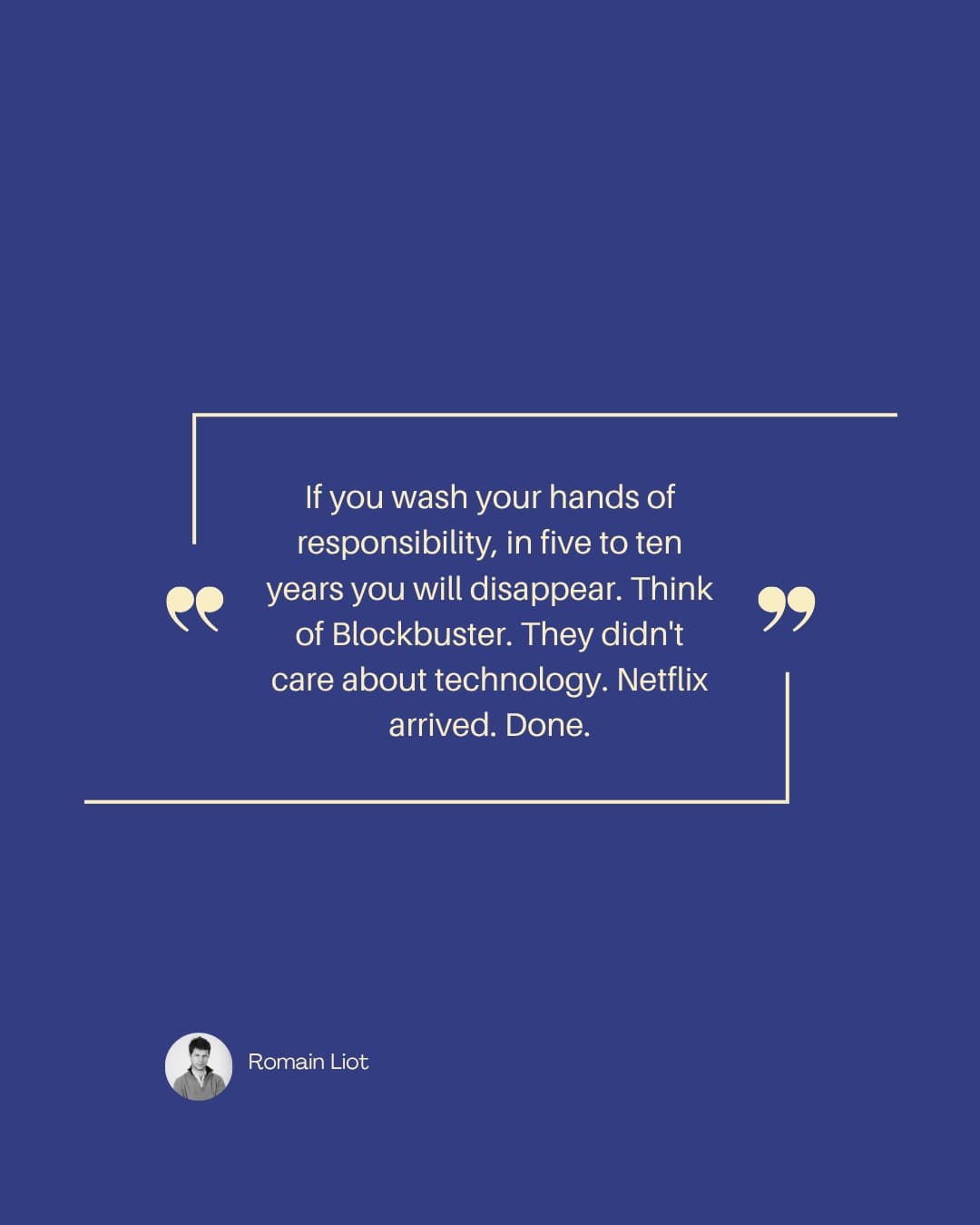
So I think brands that just wash their hands of responsibility are making a bad strategic choice. They have a duty to survive and to be successful. So if they do nothing today, they might get away with it for one or two years. And then they'll suffer big time. And they know that. So they can't escape their responsibility.
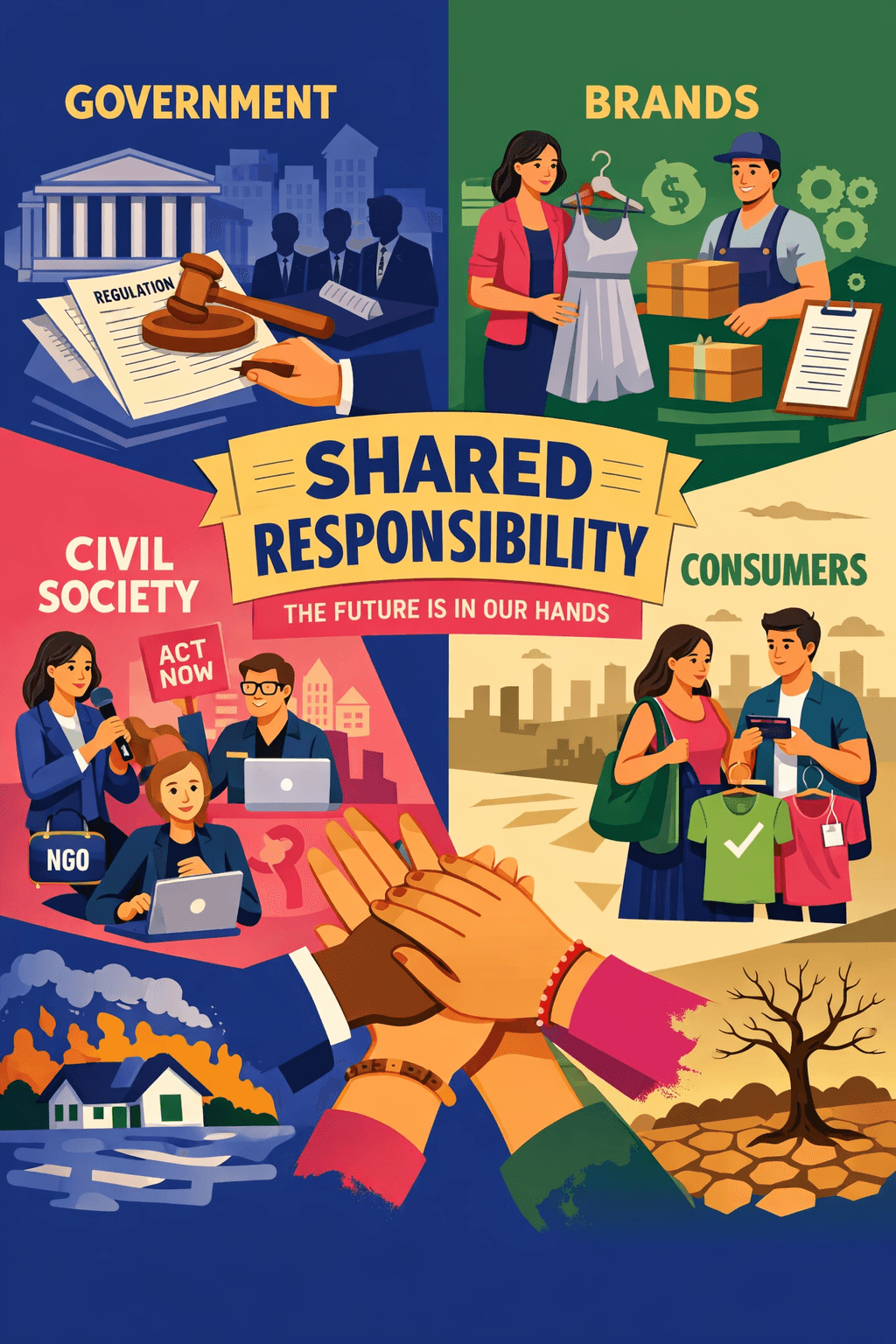
Then you have civil society — NGOs, researchers, journalists, and so on. I think they have the power of influence. They don't have prescription power, but they can influence the prescription power of regulators, and they can also put pressure. I think they have this secret power, and they look more legitimate sometimes, more fair, which isn't always true, but let's say they have this prestige. So I think it's good, and I think their responsibility is to make sure we're steering in the right direction. And I'll give you an example where I sometimes challenge a little bit the way it's steered, but I think they have this responsibility.
And then there's the customer. Mixed effect. Yes, they should buy more responsibly, and they do, but a bit too slowly. But at the end of the day, customers buy what is offered. So it sounds a bit cynical, but they react in an almost expected way. Take electric cars — Chinese electric cars are great, so customers buy Chinese electric cars, because they fit their constraints better. It's a pity there aren't better electric cars made in Europe. We could say, oh, they should buy expensive European-made electric cars, but they'll buy the ones that fit their budget and their needs. So of course it's good to encourage them, but I won't put too much of the burden on the customer — they're trying to manage their own agenda, and they buy what's offered to them.
So I think it's more a question of supply and demand within the fashion system. Even if I encourage every customer to vote with their wallet and buy more expensive brands.
You mentioned challenging civil society a bit. I want to follow that thread, because that surprised me. We generally think of NGOs and watchdogs as the good guys. What's the critique?
I think the duty they have is to really know the topic, its complexity, and to favor nuance, to help people be more educated. Here's an example. In Europe, it's considered cooler to say a garment is made close to home — within Europe, say Portugal, or in Tunisia — than made in Asia. Because 'made in Asia' sounds very bad, because of transportation, this imagery of a boat crossing the world five times. Okay, it's true, but it's a bit short-sighted, because transportation of a garment is 1% to 3% of the total production carbon emissions of a product. So you're only talking about 3%. The energy mix is much more important — are you making your product with coal or with electricity? And it turns out that, for instance, in countries south of Europe, the energy mix is very bad. So if you make the same product in Sri Lanka or in Turkey, everything else being equal, it's better for the planet to make it in Sri Lanka, just because of the energy mix. That doesn't mean we shouldn't make products in Turkey, there are other advantages, it's close by, and they're also upgrading their energy mix. But it shows that some things are a bit counterintuitive.
So the Pavlovian idea that 'produced close by is better for the environment' — I don't think that's true. I think it's good for many reasons, but I don't think it's good for the environment if you really care about climate warming. So that's, I think, an example of where civil society needs to be a bit more nuanced.
Another example: some fashion brands make a lot of effort and are leaders on many fronts, investing a lot. But it's such a mess that you still get glitches. And when somebody finds a glitch, it triggers a burst of outrage that's not really correlated to whether it's actually bad or fair — it's more correlated to whether it's a big, well-known brand that can be slapped. So if a big brand gets caught in some minor fraud, whatever, people will only see 'oh, they're villains,' and they'll be happy with that. I think it reinforces the passions of people into hearing what they want to hear. But I don't think it's fair. And the result has a real impact — a lot of brands end up doing more than what they communicate, because they don't want to end up under the radar. So that's a good example of the calibration civil society needs, to steer things in the right direction. Anyway, long story short: everybody has a role to play. I think the roles are complementary. It's not easy, but I think the more genuine collaboration can exist, understanding the different constituents and leveraging everybody's secret power — because everybody has a secret power the others don't — will be key to actually making fashion more sustainable.
Okay, let's talk about technology, because I think a lot of people have hope placed there. The idea that AI, sensors, blockchain, digital passports, that tech will kind of come in and fix what we can't fix through willpower alone. Is that hope realistic?
Great question. Yeah, technology will be important in changing the way fashion does fashion. Technology won't make fashion more sustainable per se, because the reason it's not sustainable is that there's a process of transforming cotton into a shirt — but technology can help make the physics smarter, more optimized. And there are also a lot of innovations that aren't tech per se, but chemistry and things like that, that also unlock a lot of opportunities. So yes, I think technology will be necessary to make fashion more sustainable.
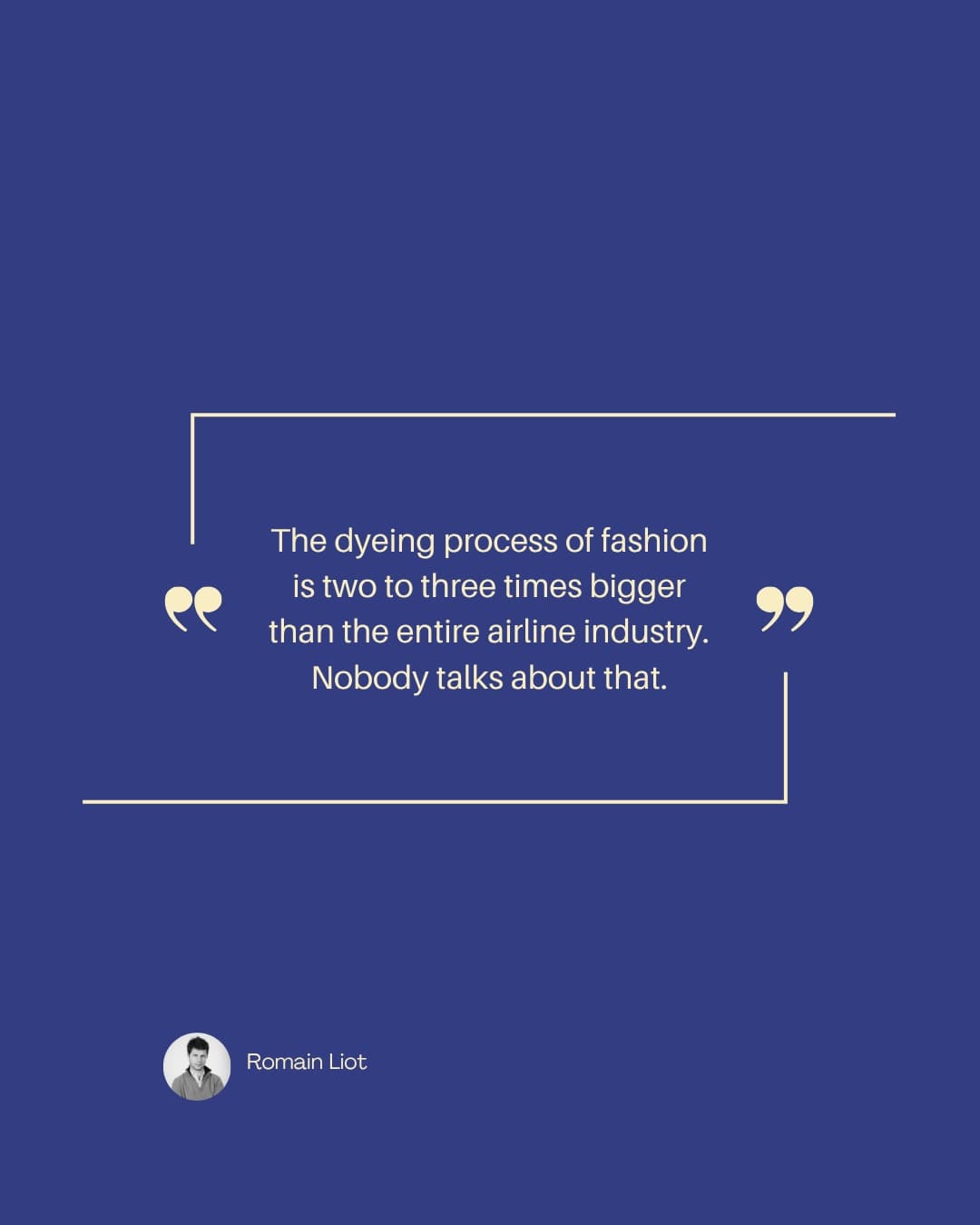
More specifically on traceability, I think traceability will be useful to create a kind of map of where to work. It's not some fancy gadget for customers to check their digital passport — I don't think most customers would care. It's more about helping figure out where we should work to reduce our carbon emissions. For instance, within fashion, half of the emissions from fashion products come from dyeing, the coloring of the garments. This used to be white cotton, and now it's white and red. This process, half of the carbon emissions of fashion, means 4% of the total carbon emissions of the world — that means the dyeing process of fashion is two to three times bigger than the airline industry. Nobody talks about that.
It's just insane. But it's happening in tier two, tier three — the supplier of the supplier of the supplier of a brand. And it's not easy to know who they are, because it's kind of scattered all over the place. But with traceability, you can know where the dyeing of a given shirt was done. Was it in some kind of responsible dye house in Bangladesh? Or was it done in a very primitive dye house in Indonesia that's only powered by coal? And once you know, you can take action — you can say, well, can we upgrade the capacity of that primitive Indonesian dye house to make it more responsible? And then you have technology that can help, with a bit of AI and sensors, to better optimize, or even use a different process. So traceability helps you know where to look — it's like a treasure hunt, you have a map of where the treasure is. So I think the main value of traceability isn't that it's useful for customers, it's that it's useful for brands that really want to work on what matters.
The dyeing statistic is just insane. Two to three times bigger than the airline industry. The same airline industry we're told to feel guilty about every time we book a flight. And it's the coloring of fabric? That's almost too simple to be real.
All in all, fashion has a huge problem. It produces more emissions than all international flights and shipping combined. It pollutes water, trashes unsold clothes, a truckload every second.
And while that sounds distant, the truth is it's driven by us. We own more than ever, yet feel like we have nothing to wear. We buy more to fix that feeling and the cycle repeats. I know because I've lived it. Closet full, nothing to wear, stress before school, work, events. I thought clothes were identity, expression. And they are. However, not the way fast fashion has taught us.
It's a system design failure. Most people wear only 30% of their wardrobe. And 61% still say they struggle to find something to wear. That's why I'm building a styling app. My app helps you preserve the stories in your wardrobe by styling what you already own, buying only when it truly makes sense.
We are getting close to the end and I want to finish with something real. Not forced optimism, but actual grounded reasons to believe this gets better. What gives you hope?
I'm an optimistic person. First, I think there's a lot of low-hanging fruit — it's actually easier to decarbonize fashion than other sectors, to start with. Second, I think we have this rare conjunction of maturity of the project, and customers getting a bit sharper too. People feel every day like the world is collapsing, so there's a kind of creative combination there that can bloom on the fertile ground of a lot of regulatory work that was done a few years ago. And the regulations aren't stopping — they've actually been slowed down in Europe, but every year the bar is still going up. So I think we're entering a world where this combination of needs and opportunity gives some hope.
And the second reason is more about the fashion industry itself. I think it's an industry that's extremely influential. And if fashion can transform itself towards more responsible practice, I think it will have the power to influence other industries with similar pitfalls or challenges. I think fashion is interesting because it's not worse or better than other industries, it's just a caricature of the consumerism and capitalism we live in. So it's easier to see what doesn't work, because it's such a caricature. But if it transforms — and I think it's possible to transform within five years, in a spectacular way — I think other sectors will be influenced, because fashion has this magical power that goes way beyond its economic weight, which isn't that big compared to, say, technology.
Before I let you go, the book. Tell people what's in it, where to find it, and who it's for. Because I feel like this isn't just a fashion industry book. It's wider than that.
The book has just been published. It's called Reset Fashion. You can find it on Amazon, to make things simple — it's available worldwide on Amazon, and in some bookstores, depending on where you live. I cover a lot of topics in the book. I try to take the point of view of an operator, because I was more an entrepreneur, I'm not a theorist of fashion, I'm just somebody who did it. It's pretty holistic, because I really think you can't understand sustainability in fashion if you don't understand fashion in its multifaceted approach. So I talk about the pitfalls of how sustainability in fashion is done. I also talk about how fashion as an industry has been destabilized by multiple trends — e-commerce, fragmentation of the supply chain, Chinese brands, tech, social media, regulations. There's a lot of destabilizing factors you need to understand to understand sustainability in fashion. And then I try to cover what needs to be done for the industry. We talk about technology, traceability, but there's also a lot of engineering-level detail — there's a lot of cool technology being done by different brands that people don't know about, like Decathlon, Nike, Uniqlo. They're doing cool stuff people aren't aware of, and I talk about that. We talk about collaboration, what type of collaboration needs to happen between players in the industry to be really efficient. We talk about HR, what type of skills people need for this transformation. And we talk about purpose, because at the end of the day, it's a collective project. What do we want to do, individually and collectively, in a company, in an industry, and for our planet? So, time to reset fashion.
Here is what I keep thinking about after this conversation.
We are so used to sustainability being about guilt. Don't fly, don't buy fast fashion, feel bad about your closet. And I get it, those things matter. But Romain is saying something different. He is saying we are solving the wrong problems. We are turning off lights in offices while the real fire is burning three suppliers deep in a supply chain nobody has mapped. And the people who should be mapping it are busy designing pastel collections for 10% of the market.
That's not a consumer problem. That's a system problem. And systems problems need people who are willing to be honest about them. Which is exactly what this book and this conversation are trying to do. Reset Fashion by Romain is now out on Amazon.
Read Reset Fashion
Romain Liot on the pitfalls of sustainable fashion — and what actually needs to change.
Explore the bookAnd if you've been curious about this space but couldn't tell the real work from the greenwashing, this is genuinely a useful read.
If something in this episode made you stop and think, good, that's the whole point. Curious by Design is about finding the story behind the obvious one. And fashion? It's got layers, literally and figuratively. Every episode this season pulls on a different thread. I promise you, it unravels fast. And if you like this, share it with one other person who would never expect to find themselves genuinely gripped by a conversation about clothing. Those are my favorite listeners. Stay curious and I'll see you next time.