

The Price Is Not for the Shirt
Inside the only full textile sorting plant in the DACH region: 70 tons of clothing a week, 200+ sorting criteria, and a job-training program running alongside it.
Featuring Nathalie Steiner | Carla Vorarlberg (Caritas)

About this episode
Carla Vorarlberg is a social enterprise run by Caritas that operates five second-hand shops and the only full-scale textile sorting plant in the DACH region (Germany, Austria, and Switzerlan). Nathalie Steiner walks Tori through what happens after a bag of clothes goes into one of the operation's 470-plus donation containers: roughly 70 tons of textiles move through the sorting hall every week, each garment assessed against more than 200 criteria before it's resold, recycled, or set aside. The sorting floor also doubles as a job-training and reintegration program run with Austria's public employment office. The conversation closes on a misconception Nathalie hears constantly (that second-hand prices are somehow unfair) when in reality they're covering real sorting, labor, and logistics costs that a fast-fashion price tag never shows.
The conversation
You know those white and red or white and blue containers on the street? The ones you stuff your old jeans into and then sort of forget about it? I used to do that too. Drop the bag, feel good about myself, move on. But a while back I started wondering, what actually happens after that? Like, really, where does it go? Who touches it? Does it even make a difference? Turns out the answer is way more interesting than I expected. And it has very little to do with what most of us imagine.
Here in Austria, and especially here in Vorarlberg, it turns out there is a whole world behind that drop. A social system, an ecological system, and honestly, a really beautiful human story. Today I'm talking to Natalie from Carla Voralberg, a social enterprise by Caritas that runs five second-hand shops and, most fascinatingly, the only full textile sorting plant, a so-called Vollsortierung, in the entire DACH region. That's Germany, Austria, and Switzerland. Just one. And it's right here in Hohenems.
Hi, I'm Tori and welcome to Curious by Design. This is a podcast about the hidden systems behind everyday things. The quiet decisions, the invisible chains, the stories nobody tells you, but that shape your life more than you think. This season, we are pulling on one thread. Fashion. Not trends, not aesthetics, the real stuff: materials, labor, power, and what it actually costs to get dressed in the morning, beyond the price tag. So let's get into it.
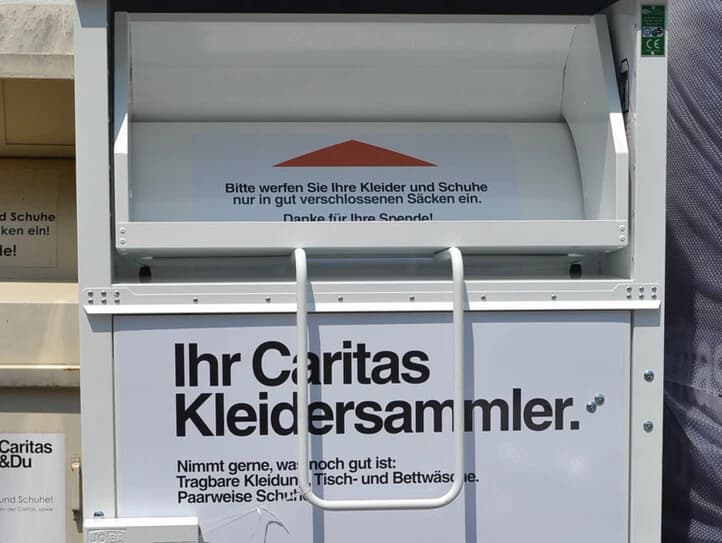
Let's start at the very beginning. Someone like me, or you listening, fills a bag with clothes, walks to the container, drops it in. Done. But for Carla, that's actually just the starting gun.
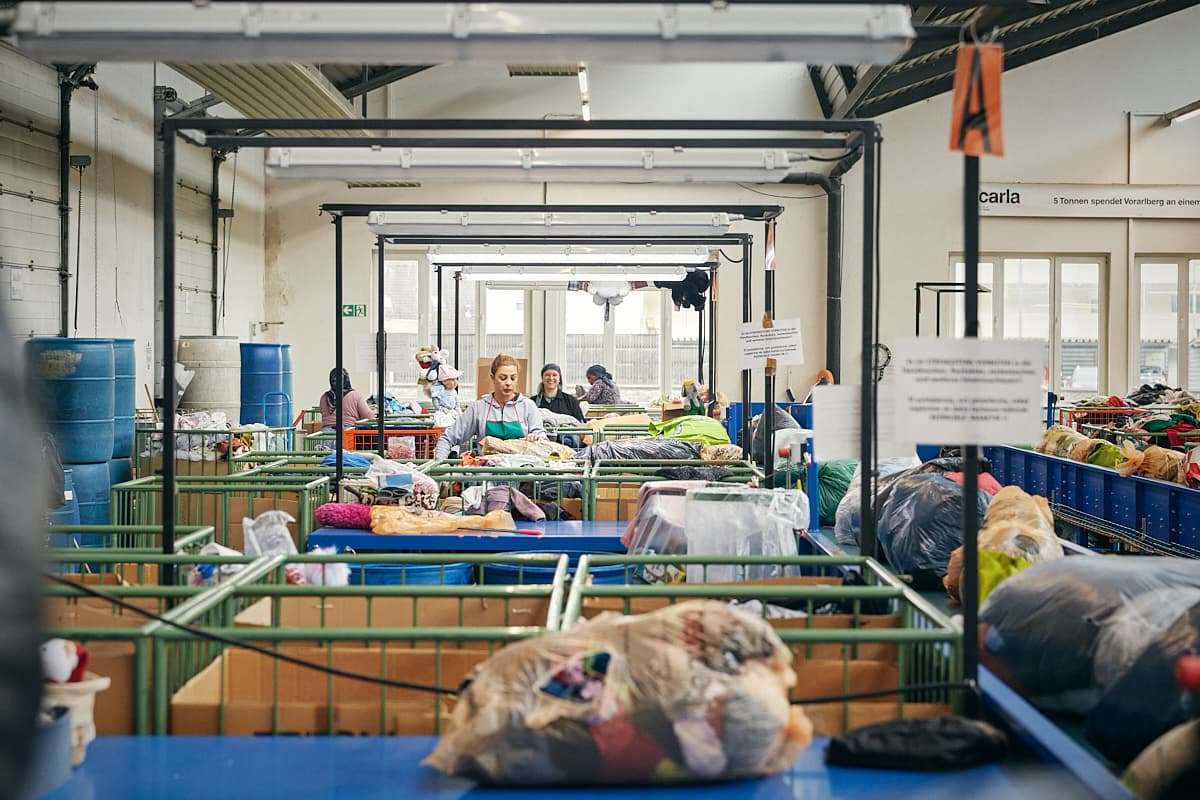
So here's what actually happens. Those around 470 containers scattered across Vorarlberg, they don't just sit there forever. Carla has a logistics team that goes around, empties them, and trucks the bags back to the sorting plant in Hohenems. About 70 tons of clothing arrive every single week. 70 tons a week.
70 tons
of donated clothing arriving at the Hohenems sorting plant every week
Collected from roughly 470 containers across Vorarlberg.
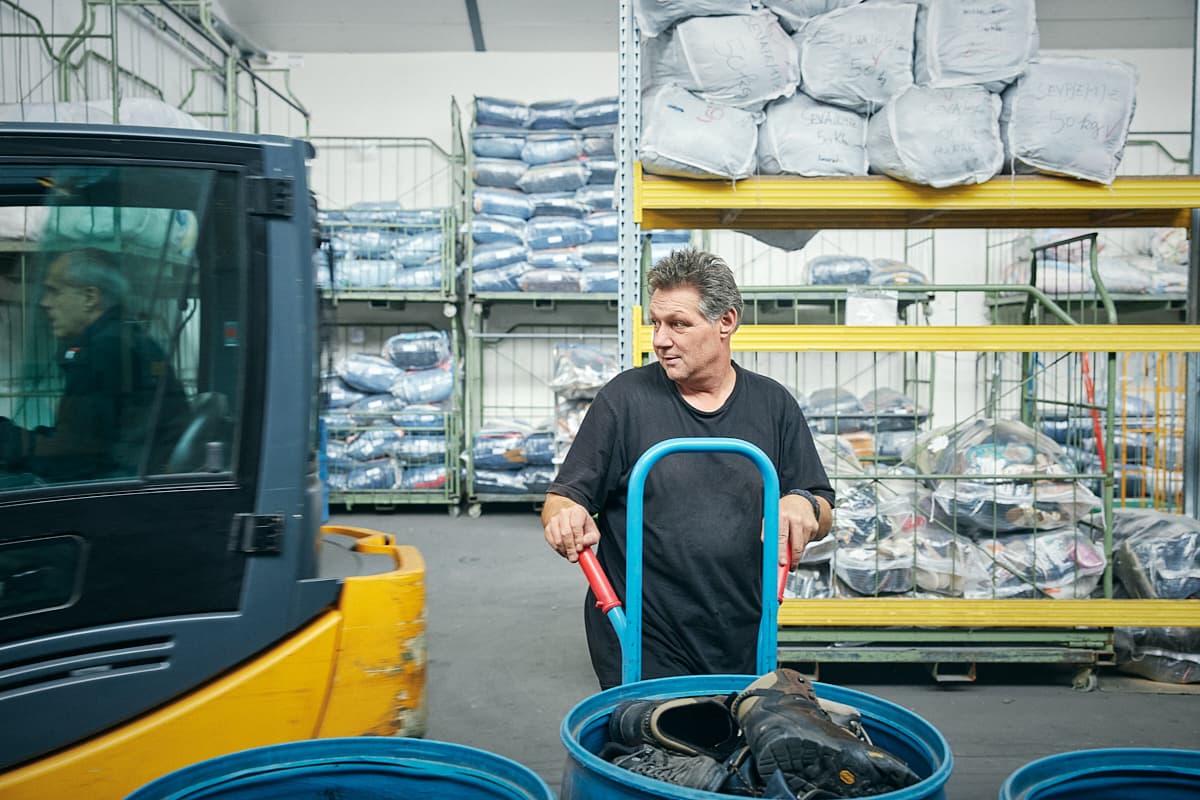
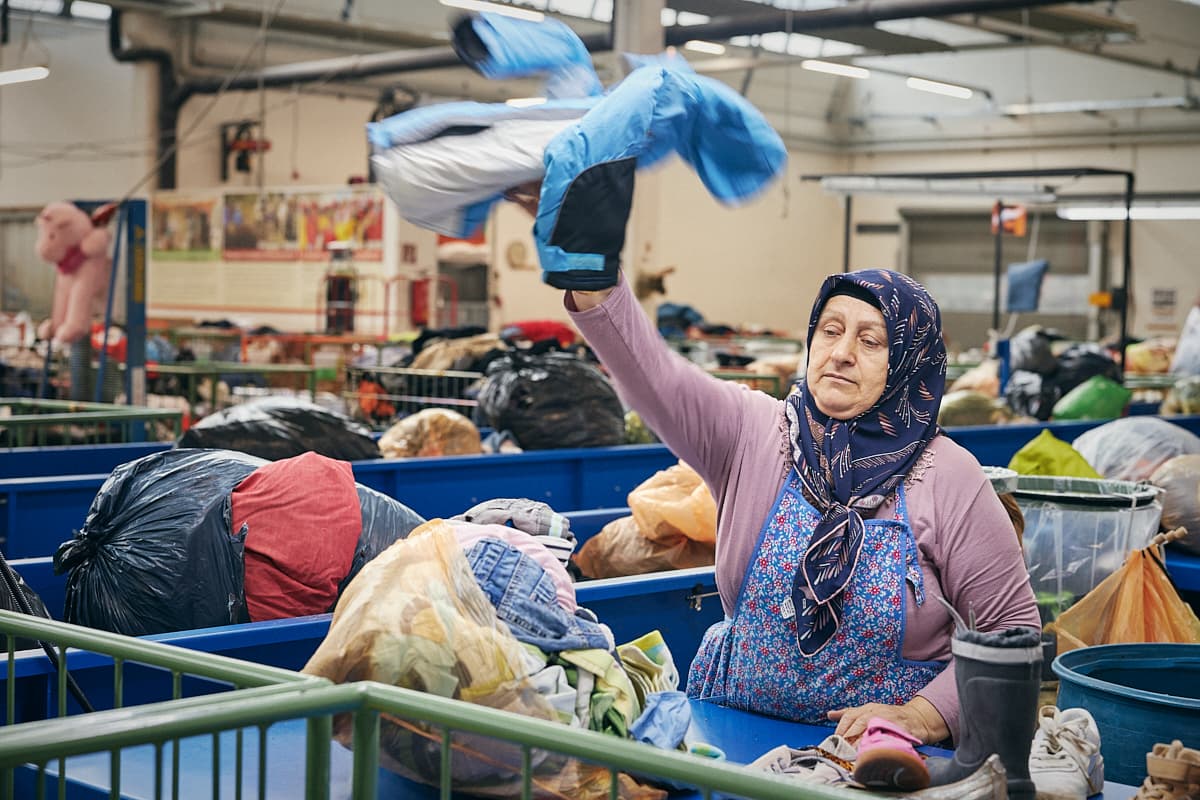
When the bags are there, workers open them. And yes, sometimes what comes out is not exactly a pleasant surprise. People donate things that are damp, moldy, broken, or honestly just not clothing. So step one is already a bit of an adventure.
Once the bags are opened, the real sorting begins. And this is where it gets fascinating. The sorters work through each piece manually, feeling the fabric, checking the condition, reading the label, and they are evaluating against over 200 different criteria. Not just is it a shirt, but what condition is it in? What material? What style? What size? Does it have a market right now? Can it be resold or does it go somewhere else entirely? And it's like a full audit of every single piece. That's what a false or tearing actually means. Only 23% of what comes in ends up actually discarded. 23%. That number surprised me. The goal is a recycling or reuse rate above 90%. Nothing is just dumped. Everything is assessed. And that level of detail? It matters so much more than you would think. It's the difference between a jacket finding a new home and ending up in an insulation in a building wall. Both, let's agree, are better than a landfill. But one of them means someone gets to wear that jacket again, maybe for the first time in their life. That's how Natalie explained the categories.
Categories, they are not only like the category of clothing, but also style-wise. So now we have a rock category, which is being sorted and sold like crazy. Because apparently there's a market.
Vintage. A few years back, vintage was not being sold. Because nobody wanted to have this old-fashioned kind of clothing, right? At this point, vintage, perfect. We have an entire vintage store. So with changing style, there's also changing market demand and changing categories. Quality stays the same. Like the quality evaluation, that's always going to be part of it. But the categories, there's a whole bunch being added on a regular basis. And if there's no market demand, also being stopped.
So, given how much work goes into every single piece, I wanted to ask the obvious question. What should we actually be putting in those containers? Because I think a lot of us are guilty of using them as a guilt-free way to throw things away. Like, if it goes in the container, it can't be my problem anymore, right? Natalie had a pretty clear answer to that.
Best case scenario, people sort out their wardrobes on a yearly basis, maybe, and things that they have no use for or no longer are directly being packed up and given to Carla. Not only, but also because the market, like the longer that they stay in the wardrobe, the less they're likely to be fashionable, for example. Sometimes even quality decreases depending on the clothing, right? So best case scenario, as long as you really have no use, collect and give away the clothing that you would also be using but no longer have use for. Meaning washed clothing that if possible has none or little holes, for example, that has some sort of use. Such a half cut off shirt with no sleeves and a lot of stains.
What are we going to do with this? We are collecting and we are sorting it out. These are the kinds of clothing that will probably go either to construction or cleaning racks, preferably clean clothing that has no longer a use in the household, but could potentially be reused.
Washed, reusable, as little damage as possible and ideally donated sooner rather than later. Makes sense, but there's another layer to this that I haven't thought about.
Even good quality clothing has to fit the market, which means someone at Carla has to know what is selling and what is just stacking up. I asked Natalie if they have a market research team for that.
I think the big, like most of the information we get from the stores themselves because they see what is being sold, what is just stacking up. They see trends, they're aware of the trends. So I think the information comes from the ground. So there's no specific person that has studied market research and developed strategies. No, that's the information that comes from the ground and that we're working with. Such jobs are very expensive, let's say. And we much rather depend on the market, the information from the people on the ground. And so far it's working perfectly.
Let's talk more about people working there. Because this is where Carla's story stops being just an environmental one and becomes something much more personal. About 50 people work in the sorting plant. And many of them come from backgrounds that made finding a job incredibly difficult. I asked Natalie to tell me more about who these people are and what this work actually means for them.
So one big and very important collaboration for us is with the Arbeitsmarktservice Vorarlberg. So we are strongly collaborating with the unemployment office from the area.
And we have two main goals, right? One is circular economy. The other one is work market policy. And work market policy, this means that our main focus is on people, that are disadvantaged on the work market. So what we are doing is we're collaborating with the job center pretty much and people that are unemployed are at one point being, let's say, sent to us. They have job interviews with us and we have a whole bunch of job opportunities here, low-key job opportunities that allow for people that have been far from the work market to reintegrate. And that's our main goal, right? To meet the people where they are and try to provide all they need in order for them to at some point be reintegrated into the first market, so the first job market.
So this profession here we call second job market if it's in collaboration with the job center. So what's happening is that people are being sent over to us. They have job interviews with us. We have different kinds of jobs, meaning that we have the sorting, we have logistics, we have electronics. We have the shops, right? Like literally the selling in the shops, we have also sorting not only for clothing but also for all sorts of dishes, of furniture. Things that you could probably imagine to be needed in a household. So this is one other part that we have, right? So there's a whole bunch of job opportunities.
So we meet the people. Very important where they live, so that the job offer is closest to where they live, right? And then also what their interests are. And based on this, we offer them a work training. This is about six weeks, so they start with us. They have a work training for six weeks. If that goes well, they transfer into a contract. Usually people are with us around four months, maximum of 12 months, which is what we are allowed by the corporation legislation and funding. So within this time, so the on-the-job training plus the contract, the people are employed, they have insurance. They have social workers that are supporting them.
We have people that are supporting them with the job searching, with the application. Part of the project, or one project in specific, is one where they also undergo trainings. So workshops in specific on reuse and circular economy. So yeah, this is I think the main goal why we're doing this: to support people that are disadvantaged. There's a lot of big stories, obviously, right, so I think being unemployed in Austria is something that can be very stressful. Unlike what other people might think, the biggest percentage of the people that are coming to us are involuntarily without a job, right? So they've been trying for years.
There's people that have fled from their home countries because of war. There is elderly people, which is not necessarily elderly in that sense, but for the work market, too old. That could be women after 45. Very hard to find a job. Women that have children at home or people that are taking care of their parents, if they need care. So there's a lot of life situations that don't fit the needs of our job market, and we have very flexible work times.
We can adapt to the needs of the people to a very high extent compared to the first work market. Plus we have people that are trained to support these people that come with baggage, with stories. Not saying like everybody has stories, right, but I think those people are often overlooked.
I myself am leading one project that's funded from the European Union. It's called ESF Reuse, and with this specific project we also have qualifications, and I've seen many people that have horrifying backgrounds and disadvantages on several levels: might be a language barrier, might be a health barrier, like physical and mental health. So there's a lot of baggage that comes with it, but with the right support and the right surrounding and time to adapt and re-enter the market, it's very often a big chance for them to breathe while actively taking steps towards the first work market. And they're being then slowly but surely supported to really apply for jobs. They're trained to have job trainings, job interviews, like they're really being supported on all ends. And I think that's a very valuable thing, that you have this safe environment while having work, so they are contracted, right, so they're no longer unemployed, they're contracted with support, with their needs considered. And I think that can change a life if the opportunity is taken seriously.
I don't think I was prepared for how much that would hit me. Like, you go in thinking you're going to learn about textiles and you come out thinking about women over 45 who can't get hired, and refugees, and people who are just... trying to breathe while getting back on their feet. And Carla gives them that space. With a contract. With support. That's not small.
I have to say that, and I find it so valuable, and it warms my heart every time. And they're so grateful, mostly. And such sweet people. And it's impressive to watch the change of a person when people actually start to believe in them. What I wanted to say is that I'm conceptualizing, I'm doing the funding, you know, I'm doing the reporting, all these controlling things. I'm working with data a lot, right? I'm practically never or almost never on the ground. I find the impressive part is really our social workers, the people that are supporting them on a daily basis, working with them in the locations, in the shops. So that I find very impressive.
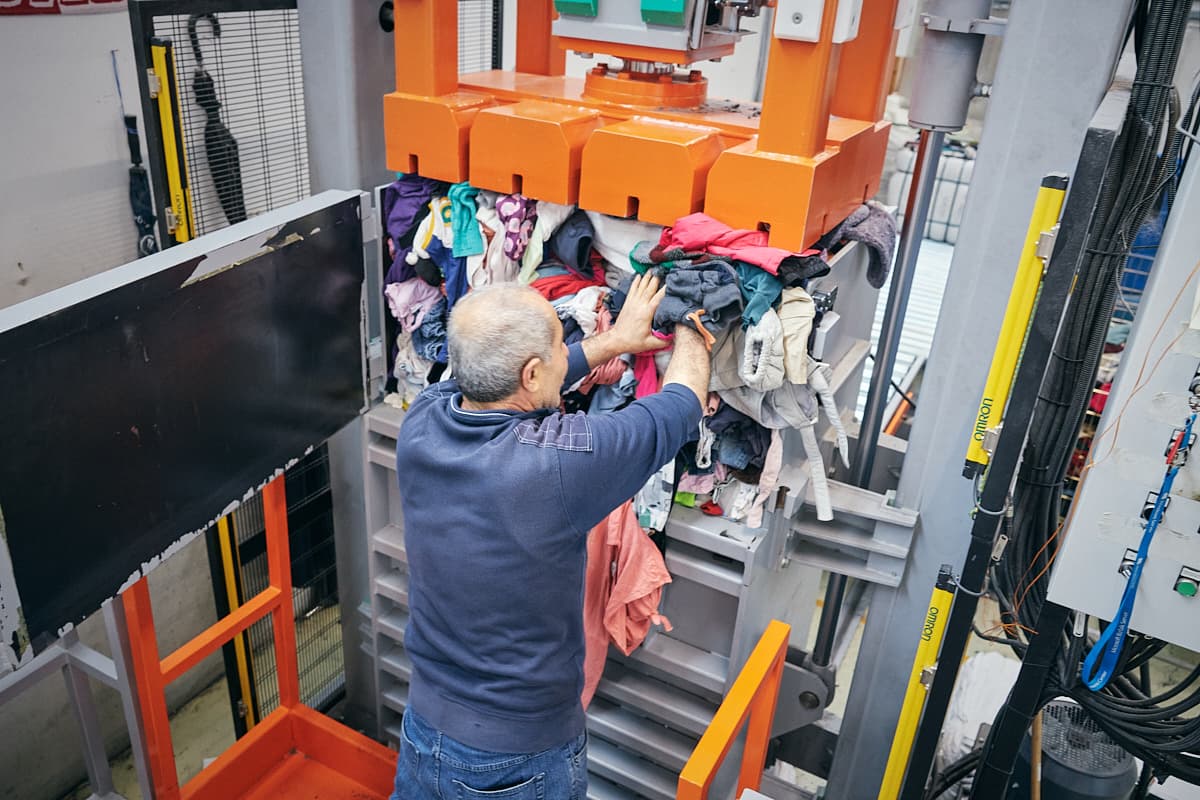
You mentioned that some textiles, the ones that can't be resold and can't go to construction or cleaning, still don't just become waste. So I'm curious: do you ever go in the other direction? Does upcycling play a role here?
We do have projects as part of the aim to keep the waste at a minimum. So this collaboration that I mentioned earlier with the art university in Linz, we're collaborating with them and they're providing the expertise in industrial design. So there we've been working on high-end design products that are being made out of used textiles that have no market in Austria. So this is one example for how we try to get more into upcycling.
We also are slowly growing a collaboration with the same university, but a different area, which would be fashion and technology. So we are definitely trying to get more and more into collaborations with universities to do research on how we can avoid waste, right? So yes, we are. And the goal is big, let's say, to have zero waste, but we are on it.
That's a good goal to have. Zero waste. I love the ambition. But I'm also curious, from a systems perspective, how do you hold both goals at the same time? The social mission and the environmental mission. Do they ever pull in different directions, or does it just... work?
First it goes hand in hand, because the jobs we have are all green jobs. So for us, circular economy and social support go hand in hand. On a higher level, meaning on a country level, it gets a bit more difficult, because the fundings are either social or used to be either social or for circular economy. So now we are slowly starting to build cases where we show that these go hand in hand, and it's slowly but surely moving into a direction that is very beautiful to watch and is helpful for us.
For us, it's the most natural thing we could do. Also given the circumstances, because how we came into existence was with the declining textile industry on site, that led to hundreds over hundreds over thousands of unemployed people that initially were trained or worked in a textile industry. So this is where Caritas came in. Caritas already existed, but Carla didn't. So what happened there is that we tried to create jobs for the people, and the closest or the most logical thing to do was to continue to work with textiles. But at this point they decided to work with used textiles, because there is already value in this as such. So given the context, it's a very natural thing.
Sometimes it's very hard to explain that these two things go hand in hand, but we are trying to work on that.
One of my episodes was actually about how we lost the knowledge of wool production in Europe, how whole textile traditions just quietly disappeared when the industry moved. And hearing Nathalie talk about how Carla grew out of that exact collapse, using the knowledge that was already there, just turning it toward something different, honestly felt like a full-circle moment. So, naturally, I had to ask: in a world where fast fashion is only getting faster, where does Carla fit in all of that? What does it mean to be a best-practice model in circular textiles when the system around you keeps pushing in the opposite direction?
So we are highly active when it comes to specifically European legislation. On an EU level, there's a lot going on with the Circular Economy Act, with circular textiles. So there are a lot of points that favor reuse. So we do definitely position ourselves. We are collaborating with Austrian and European stakeholders in that matter to increase the value, the weight of the position. And we are pressuring more and more towards the increase of reuse and the decrease of fast fashion. It's a very difficult endeavor, and there are people all over Europe that do try to foster this change, right?
On a regulatory basis, there's a lot of work going on with a circular textile strategy, starting with the Green Deal, right? From there on, there's been a whole bunch of initiatives that move towards this direction. So we are strongly positioning ourselves, trying to build alliances. That part is what we're doing on a European, legislative level. For us on site, we do really struggle with fast fashion. It happens more and more that what we are collecting are fast fashion textiles that have a diversity of textiles in them. Most of it polyester, or textiles that, first of all, can't be properly recycled, have no quality or very little quality. More often than not, they're still new. So there are several occasions where we receive, let's say, six shirts in different colors, same size, new. Because I assume it's cheaper to buy fast fashion, let's say Shein, in all kinds of colors, and it's still cheaper than buying one good quality piece. So, economically, it might make sense.
Our problem is that this would still be considered reuse. And they usually have no stains, because they are still quite new when we receive them. But quality-wise, they meet no standards. If there's a high percentage of polyester, the quality decreases. It's very rare that we receive textiles made of one specific material — that would be the perfect situation — but the cleaner the clothes are, and I'm not talking stains, I'm talking construction of textiles or mixture of textiles, the higher the quality usually. That doesn't go for work clothing, because that has different requirements, right? But in general, and now I'm talking reuse, but even more so for recycling, for example: the more different textiles are to be found in one piece of clothing, the harder it will be to properly recycle, to deconstruct.
And this is also a movement that is going on right now, sustainable design, so that products are more and more required to be designed in a way that they can be kept in the circle as long as possible, potentially be recycled. Eco-design is the term.
That quality question led us into something I genuinely had no clear answer to, and I'm guessing you don't either. We talk a lot about natural vs. synthetic fibres. Cotton, linen, wool on one side. Polyester, nylon, acrylic on the other. There's this general cultural feeling that natural is better. But is it actually? I asked Nathalie for her take, even if it was just a personal one.
Very good question. So again, on a European level, there's very specific criteria. Durability is one point. Recyclability is a point. There are certain quality requirements, of course, in the textile industry.
For us specifically, there's an entire list of what sustainability means on a European level, considering textiles. It is very true that the materials where we would easily say good quality, like cotton, like linen — just looking at the water consumption, the transportation of these materials — that could be highly problematic, right? Especially looking at the amount of clothing and the consumption that we have. I'm not saying polyester as such has bad quality. I could see why the argument would be that we wouldn't need the resources from all over the globe. I don't know enough details to prove or disprove that.
But I think the goal in general would be to first of all make sure that we decrease the consumption, which automatically decreases the need for certain materials. By doing so, we also decrease the resources that are being used for the production of these materials. That's one thing. Next thing is to make sure that the value chain is sustainable, in a sense where human rights are being met all over the globe, that sustainability requirements, eco requirements, are being met all over the globe. So if all these things are being changed, and we are slowly but surely moving towards that direction. The controlling part I consider very problematic at this point, but anyways, we are moving in that direction, at least on a legal basis.
So if this would be the norm — plus, if we would try to keep the materials in the cycle — we would, from the very start, already be a lot more sustainable. And for that, we wouldn't even need polyester. I don't know enough about polyester to have an opinion on that. I just know that our sorters consider that sometimes problematic, depending on the amount of polyester. Very interesting debate, though.
This is actually something I went down a rabbit hole on after this conversation. A study just published in March 2026 by Loughborough University found something kind of uncomfortable. Natural textile fibres like cotton and wool have been found preserved in lake sediments for over a hundred years. So the idea that natural fibres just biodegrade and disappear? Apparently not that simple. They can persist in the environment, and when they partially degrade, they might release harmful chemicals. Which doesn't mean we should all switch to polyester tomorrow, but it does mean the whole "natural is always better" argument is messier than the marketing tells us. I will link the study here.
One last sentence: I think it is important to do research on what else we could use in terms of materials that are less harmful to the environment and to the human body, right? Definitely. But on another level, I think it is at least as important to make sure that what we already have on the market, that we take the resources and try to keep them in a cycle as long as possible. Because the longer we do this, the less need for raw materials we will have in the long term.
I would say the majority of people in Austria would much rather have affordable clothing than high quality clothing if they are struggling with a budget. So how are you going to make sure that people prefer quality clothing over fast fashion if by now the quality clothing is freaking expensive? The answer at the moment is reuse, because that's where you more often than not get high quality clothing for a cheaper price. But other than that, the choice is an easy one if you struggle with budget, for example, or if you like to wear different things seven days a week, if you would like to change your entire closet every year. If this is the request, then fast fashion is the right answer. But I think, and as you say, the mindset has to be changed in that regard.
All in all, fashion has a huge problem. It produces more emissions than all international flights and shipping combined. It pollutes water, trashes unsold clothes, a truckload every second.
And while that sounds distant, the truth is it's driven by us. We own more than ever, yet feel like we have nothing to wear. We buy more to fix that feeling and the cycle repeats. I know because I've lived it. Closet full, nothing to wear, stress before school, work, events. I thought clothes were identity, expression. And they are. However, not the way fast fashion has taught us.
It's a system design failure. Most people wear only 30% of their wardrobe. And 61% still say they struggle to find something to wear. That's why I'm building a styling app. My app helps you preserve the stories in your wardrobe by styling what you already own, buying only when it truly makes sense.
So one thing I keep thinking about: we are in 2026, AI is everywhere, robots are sorting packages in warehouses. How does Carla think about technology? Could automation change the sorting process, and does that feel like a threat or an opportunity for the people working there?
We are an NPO. We are highly dependent on funding. And all the sorting steps that we're having right now are undertaken manually, meaning manual labor, meaning jobs, right, at the moment. It would be very interesting to us, and that's also a direction that we are looking towards — we try to partake in certain research projects on how to increase efficiency in sorting plants, since we do have the sorting plant, right?
We participate on-site, with the plant offering itself as a research spot. But to be able to invest in technology, in a first step, requires a budget. And I think this is also why we first try to build cases and, with the funding we already have, do research on what would be possible, what would be fitting for the specific plant, right?
And then in the next step, see where we could invest, how we could invest. And then another, last step would be to prepare and apply for funding, right? So if we think about it: at the moment it's people that are opening the bags. A lot of them are contaminated, obviously they're shielded, like, everything is very safe there. But it's not a perfect job to do, which could be facilitated with technology to substitute certain steps. But then this also opens up other job descriptions, right? So it's not only that one is taken over by technology, but it's also opening up other opportunities, potentially increasing the job quality, right?
So that's, not probably, but that's our goal: that with technology we can make sure that the job quality is being increased step by step. There is a lot of research with AI at the moment, where AI could touch and scan the textiles and already kind of pre-sort them. So there's a lot of research ongoing. No clear answer for us just yet. But it is very interesting and future-oriented, definitely. So as I said, it's probably some robotics or AI with sorting.
Before we wrap up, I want to ask you something a little more personal. You give tours of the facility. You see people's reactions up close. What do you think most people genuinely misunderstand about what Carla does or about second-hand shops in general?
So first of all, I've experienced, I've done a lot of tours here in the facility, and for some reason people don't think about the fact that there's actual people working here. I don't know what they think, but it sounds like they think you can make a shitload of money with old clothes, and then selling them is quite harsh.
What people don't see is that this is a work market project that creates jobs for people that are disadvantaged on the work market, that we have a lot of people that are being paid a decent salary based on Austrian standards, that are doing the work. That the bag they're putting in the boxes is being deconstructed, sorted, and that they find the clothing on the rack in the shops. So the steps in between, I feel like that's a big black box. That leads to a lot of misunderstandings, or a lot of critical comments, when they complain about the prices in the shops or complain about the fact that we sell the clothing.
If they knew the cost structure, I doubt that anybody would ever again complain about the fact that these prices are being presented in the shops, and they are all valid. There's a lot of work that goes into that. That's a social project. Not only, it's also a circular economy project that is very important for Vorarlberg. So I think, I don't know if that's a misunderstanding, but it's just not thinking it through, I guess. But every single time I bring people here and they walk through, I feel like there's some enlightenment going on. Like, wow, I didn't know. I didn't know. And this is impressive. And so many people and so much work.
Shops that are based on funding. Our people open up shops, rebuild them completely themselves. Everything is based on funding — if we get it, and if not, they do it themselves. They work their asses off, for the people to have a nice shopping experience, so that everything looks nice. This is not something that would be possible if the people weren't so invested, and I'm not only talking about the people in the shops, but at every single point in this chain. I know that sounds a bit dramatic. No, but it is sometimes frustrating, you know, when you know the structure, and then somebody comes up to you and complains about prices, like complaining about paying five euros for an H&M shirt. Like, okay, I get it. If they were disadvantaged, they would have received a card which would allow them to get the clothing for free or much reduced. So the people who are complaining, as far as I've seen, have never been the ones with a card. They're the ones with the money. We like to complain about high prices, which is fair on so many levels.
I'm not saying everything is perfect. We still have to consider that we are working with people that have been disadvantaged on the employment market. So it's impossible to expect a completely professional service at all times. I feel like people would have to open up for the project — if you enter one of the shops expecting that everything is perfect, well, that's something very hard to fulfill, right? We are doing our best. They are doing their best at all times. We have amazing workers there. But still, we can't be perfect at all times, and that's not the aim. I feel like the aim is more to be human, and I feel like that should be more visible and more lived.
I love that you said that. Because honestly, and I will admit this, I once walked into a second-hand shop and thought "why is this five euros?" And now I would never think that again. The price is not for the shirt. It's for everything that happened to it before it got to the rack.
I have a perfect question for the end. When you think about the next five to ten years, what gives you hope, and what do you envision for the future of the company, or the textile industry, or consumption, or whatever, to change or to be?
I love that you're talking hope, because usually there are a lot of questions about frustration, and yes, there's a lot. But hope, that's beautiful. Let's see.
I think, and I find that very impressive still: I've been here for two years, and I have never in my life, or in my time working in companies, seen so many highly, highly motivated people that really want to make a change and go the extra mile, not for the money, but for the cause.
I think that is the biggest power we have: a big team of very invested people that want to keep that going, that want to be able to compete with the market but from a human perspective, with all the goals we have, considering people, the disadvantages in the work market, and the circular economy goal in the back. So I see more and more amazing research projects upcoming. We are already there, slowly but surely moving forward, trying to really catch up with the resources we have.
And that's not even far future — we just recently opened a shop in Dornbirn, a new shop that substitutes the old one, which was very old and far off the city center. We were very lucky to get a great deal, right in the center now, and what our people created there in two weeks, a bit more, it's impressive. If you enter, it looks like a high-end shop, and I know the budget, because I basically asked for the funding, so I know what we have in terms of funding, and this is insane, what people who are creative and invested can do with so little. It's a wonderful shop, you really have to go see it. Four stores, so creative, lovely people. There's a cafe there, there's a little bar there, they just do everything, and I find that to be beautiful. So I see a lot more of that upcoming, which is so lovely. And there's another one opening in Bludenz.
What Nathalie described is something I find genuinely rare: a place where two very different goals, taking care of people and taking care of the planet, don't compete. They feed each other. That doesn't happen by accident. It happens because someone decided that was the point.
If you are in Vorarlberg, go to the Carla shops in Bregenz, Dornbirn, Altach, Feldkirch and Bludenz. Seriously. Nathalie said that the one in Dornbirn looks like a high-end boutique, and I believe her. And the next time you walk past one of those clothes containers on the street, you know what's on the other side of it now.
If this episode made you think, share it with someone who complains about second-hand shop prices. That's all I'm saying.
See you next time. Curious by Design.