

The 60% Who Care But Won't Buy
A decade of research into why sustainability marketing keeps failing the mainstream shopper, and what actually convinces the 60% who care but still buy the conventional option.
Featuring Johanna Gollnhofer | Professor of Marketing, University of St. Gallen

About this episode
Johanna Gollnhofer is a professor of marketing at the University of St. Gallen who has spent over a decade studying the gap between what people say about sustainability and what they actually buy. In this conversation, she lays out the framework from her book, The 60% Potential, co-written with Jan Pechmann: every market splits into eco-fans (15-20%, already converted), eco-grouches (15-20%, actively resistant), and a mainstream 60% who say sustainability matters and then buy the cheaper, conventional product anyway. Johanna calls the trap most sustainable brands fall into the "eco-trap" — designing, pricing, marketing, and placing products in a way that only ever reaches the eco-fans. Her argument isn't to abandon sustainability, but to stop leading with it: sell the desire first, let sustainability be the reason on the side. The conversation also gets personal, touching on Johanna's research into decluttering and why we hold onto clothes we never wear, and turns into an impromptu consulting session on how to reposition a wardrobe app that started in fashion and drifted toward preaching to the converted.
The conversation

Okay, real question. Have you ever felt vaguely guilty standing in a store holding a fast fashion piece or even just looking at your cart on the website of a shop knowing it's probably not good to buy it because you already have enough and you bank more. It's just unnecessary. It's terrible for your space in the closet and also for the planet. But you bought it anyway.
Yeah. I have to admit it happened to me also. There's this massive gap between what we say we care about and what we actually do. And for a long time, the fashion industry tried to close that gap by just talking about sustainability more. More green campaigns, more eco messaging. Spoiler, it didn't really work.
My guest today spent over a decade researching exactly why. Johanna is a professor of marketing at the University of St. Gallen and she co-wrote a book called The 60% Potential, which I have to say reframed the way I think about sustainability marketing completely. She's not here to tell you to buy less. She's here to tell you why the whole way we have been selling sustainable fashion is kind of backwards and what actually works instead. So let's get into it.
Hi, I'm Tori and welcome to Curious by Design. This is a podcast about the hidden systems behind everyday things, the quiet decisions, the invisible chains, the stories nobody tells you, but that shape your life more than you think. This season, we are pulling on one thread. Fashion. Not trends, not aesthetics, the real stuff. Materials, labor, power, and what it actually costs to get dressed in the morning. Beyond the price tag. So, let's get into it.
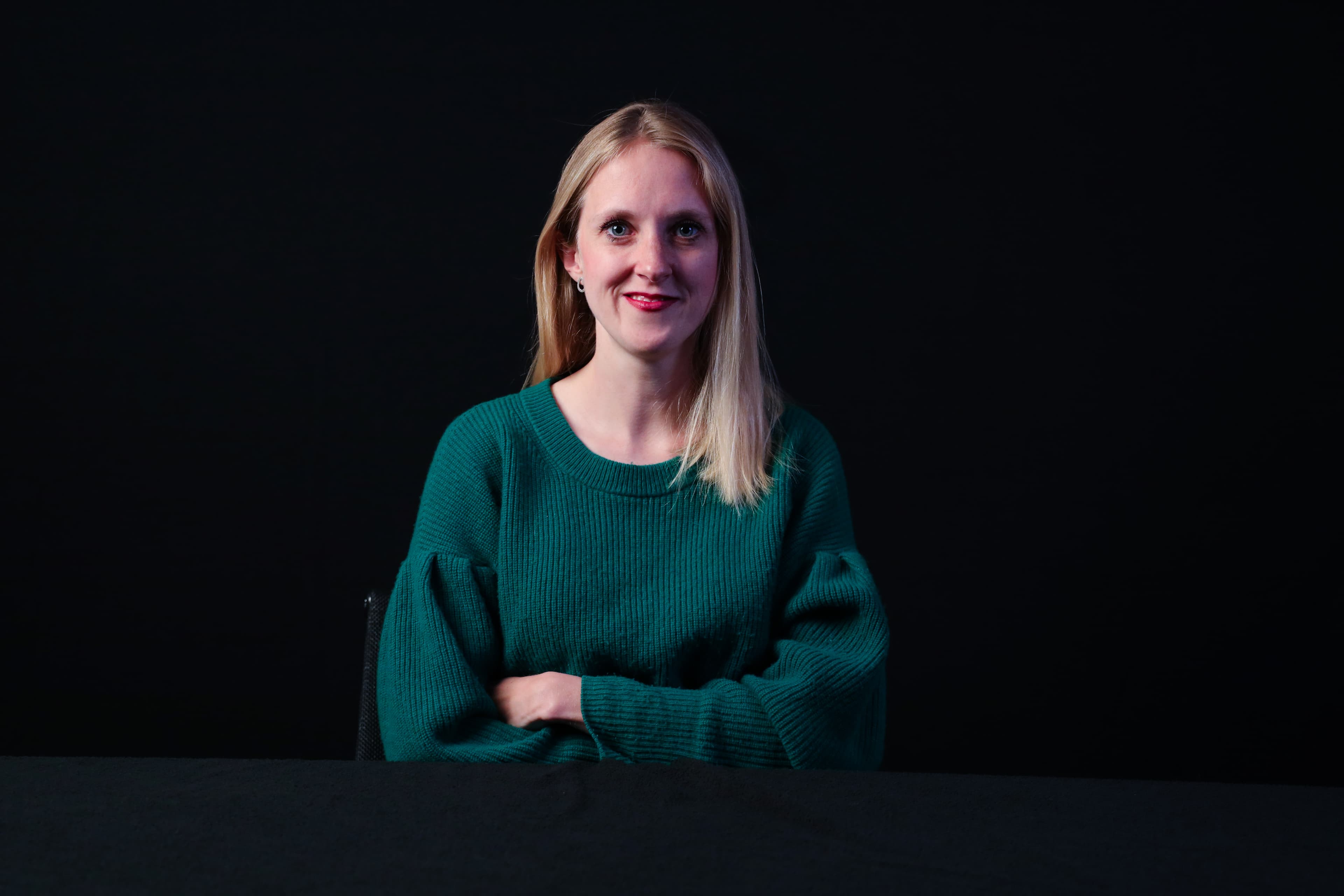
Hello, everyone, and thank you so much for having me. My name is Johanna Gollnhofer. I'm a professor of marketing at the University of St. Gallen, and I'm especially interested in the following question. How can we basically sell more ecologically sustainable products?
Amazing. And before we get into your book that you've wrote, I'm wondering, what's your own relationship with your wardrobe like? Are you secretly part of the 60% or are you an eco-fan who just understands the other 60% really well?
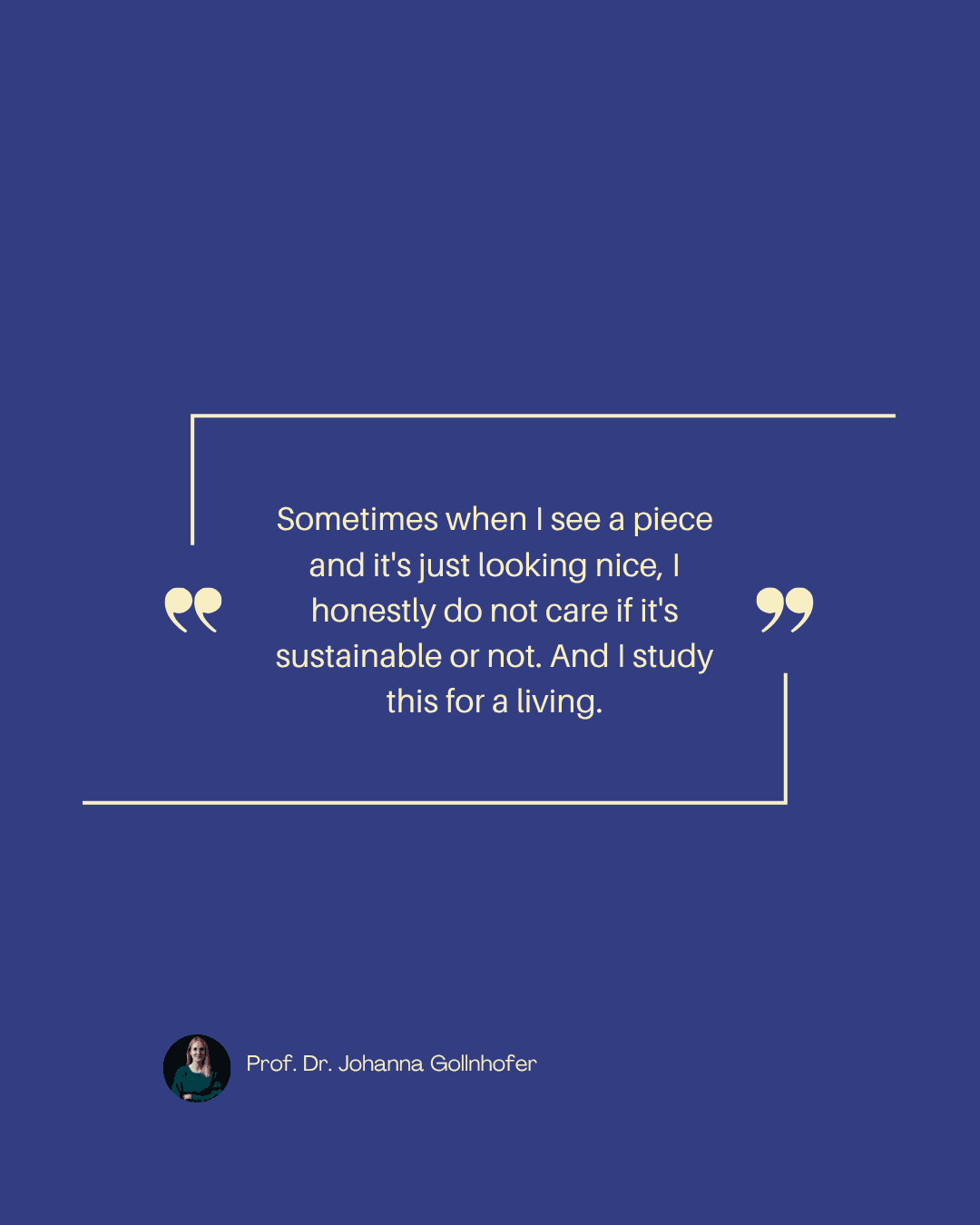
So it depends a little bit. So I have a quite minimalist weight drop. So I did a lot of decluttering and I was always focusing on the key pieces. And I also try to pay attention to sustainable clothing. But honestly, sometimes when I see a piece and when it's just looking nice... I then honestly do not care about it so much. Is it sustainable or not? Because then another priority kicks in and I just want to look at nice. So in this case, and you are there alluding to our concept that we basically outlined in our book, I'm more 60%. But in principle, I try to be more of an eco-fan.
I love that, honestly. And honestly, same. I think that's what makes this conversation so useful. You're not coming from the perspective of someone who has it all figured out. You're coming from someone who studies the gap between intention and action, which is where most of us actually live. So let's start there with the book. What was the moment you thought, okay, this needs to be written?
So I'm doing research about, let's say, the intersection of marketing and sustainability since 2012. And so I did my PhD in this area and then I followed up on an academic trajectory. And during this time, I was also visiting a lot of conferences, you know, conferences about sustainability. And it was in the year of 2019. You know, I went to all of them and one was really hyped because back then I would say it was a hype topic. And I was just sitting there and I was like, but this does not, or what they are telling me there on stage, I don't see it in my empirical data. I do interviews with consumers and they were always telling me, but consumers, they absolutely will buy sustainable products and they will pay a price premium for that and so on. And I was just like, yes, they are indicating that in surveys that hypothetically they will pay a price premium, but But honestly, by looking at the sales number and also by talking to businesses, this is not true. So this is the first moment where it basically clicked with me, where I thought, I think we have some misunderstanding here. And I think we need to correct it.
So and then over the last two years, I developed the idea further in my head. And then writing up a book takes some time. Now you also need to have a contract with a publisher house. You usually have that one a year or a year and a couple of months before it's published. This basically, this idea emerged in my head. Then I was looking for a co-author, which is Jan Pechmann. And he really comes with this practical analysis. So I always come with theory. He comes with the practical analysis. And then finally, we published the book in German in 2024 and then in English in 2025.
But for me, it was really about the misfit. Like, you know, I would love that people pay more for sustainable products. Yes, but only a minority does. Like not the mainstream consumers. And I see it in my studies, you know, and it sounds a little bit cruel, but often the tipping point is just five cents. You know, when the conventional product is five cents cheaper, they go for the conventional product instead of the sustainable one.
5¢
The tipping point
How small a price gap it takes for a mainstream shopper to pick the conventional product over the sustainable one.
That's very interesting. A previous podcast guest I had, he also argued that sustainable fashion has become like a brand, that it's beige, pastel colors, or it's like a Swedish look, kind of Nordic style. And that the aesthetic is maybe only sold to 10% of the buyers.
The problem was a little bit that when you looked into companies a couple of years ago, sustainability was always promised to be a competitive advantage. When you do it, you have a competitive advantage. And this was true a couple of years ago. But a competitive advantage means you are doing something that your competitors don't do. And when you think about it from a consumer point of view, they usually cannot tell which company is more sustainable. You know, H&M also does sustainable fashion. Are they really a sustainable business model? So you see H&M has a sustainable fashion line. Zara has a sustainable fashion line. Then you have smaller fashion providers. They all have a sustainable fashion line. And you know, for the mainstream consumer, they cannot tell the difference. It's all sustainability. So there's not really a competitive advantage.
And then also the problem is, and this is what we highlight in our book. So we look at the overarching market. And we split the market in three groups. So we find that in a lot of Western countries, you have 15 to 20% of the population, which we call the eco-fans. You know, they pay a small price premium. They really go for the ecological products. They are not in this classical attitude behavior gap. So if I ask them in a survey, do you want to shop more consciously? Do you want to shop more sustainable? They say yes. And then if I follow them around in the supermarket, they do so.
But then at the other extreme, you also have 15 to 20% of the population and we call them eco-crouches. And you know, they don't care about sustainable products. They are even appalled by them because they say, this is far too vogue for me, leave me alone.
And what we have in the middle is roughly about 60%. And you know, they buy into the narrative of sustainability. They understand if we don't change anything, We already run into problems with climate and stuff like that. They also indicate to you in surveys, yeah, sustainability is important to me. But then once they are standing in the store, they do not follow up at it at 100%. They're in this classical attitude behavior gap. And, you know, the eco-fans, we already won them over. They already go for sustainable products. So the next challenge is that we need to win over the 60%. Because the 60%, those are the mainstream consumers. This is where it gets attractive for companies because hopefully they can make their more revenue and consequently profit. But this is also where we have then the big impact on the environment. You know, if we get just 3% of consumers going for sustainable fashion, it's good. Don't get me wrong. We should be really grateful to them, to those brands. But in the end, we need to convince people or we need to get as many people as possible to shop for sustainable products. And this is why we always say we need to go after 60%.
60%
The mainstream middle
Not eco-fans, not eco-grouches — the majority who say sustainability matters, then buy the conventional option anyway.
And what you're describing before from your previous podcast guest, so when he was describing, you know, you have this eco-design. This eco-design is appealing to one group, to the eco-fans. You know, the 60%. They are looking, as I was describing also in the beginning of the podcast, I need to like it. Do I always want to have it in green and brownish colors? No, I want to have it in a fashionable color that suits my type. This is also one of my priorities. And then if on the side it's sustainable, then it's okay. But I don't want it even to look too eco because now also in consumption, we express our identity through consumption. and you dress a certain way or you drive a certain car because you want to signal something to the outside. And if I'm wearing eco clothes that entirely look eco, everyone from far away from 100 meters can recognize I'm an eco. And for sure, not everyone wants to be classified as an eco.
So you're basically saying there are three types of people in any market. The eco-fans who are already converted, the eco-crouches who are actively resistant, and then this huge middle group, the 60%, who care, but not enough to change their behavior at the checkout. And that's actually where the real opportunity is. How do you win over the 60%?
And basically, I would say it's classic marketing. And in classic marketing, you always need to ask yourself, you have your target group, and they always ask themselves, what's in it for me? And when the 60%, let's try to see it visually, stand in front of the retail shelf, and they ask themselves, and they look at all of the products, and then they ask themselves, what's in it for me? Usually the answer is not because it's sustainable, or it's also not because it's regenerative, or it's also not because the company has a circular business model. So this does not answer the question for them. And they care about sustainability, but they also optimize pro-lifestyle.
And for instance, when you are standing in front of a shelf of ice cream, what's in it for you when you buy an ice cream? It's usually not because it's vegan or it's sustainable. Usually, you go after a certain brand because you trust this brand, or you just like the taste because you want to indulge yourself.
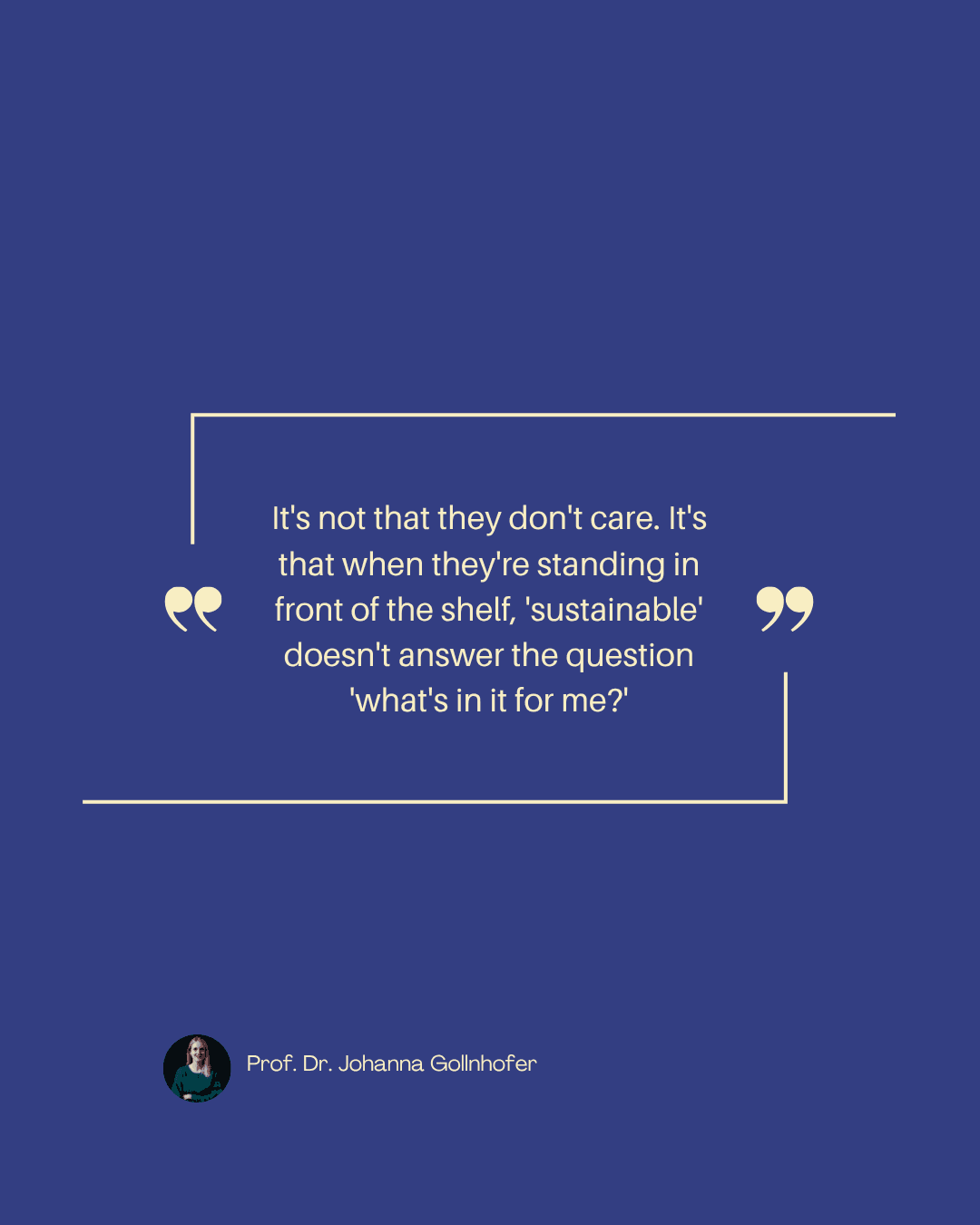
So we are definitely not saying that we don't need any sustainable products. We need them for the sustainable transformation of our society. We are just saying we need to rethink how we market those sustainable products. Because what we've been so far, we've always been saying, oh, it's sustainable, please buy it. And then only the minority was buying, no big surprise. We need to say buy it because the taste is so good. And then on the side, it's sustainable. So we are basically just flipping the order.
So don't get me wrong. It's not about greenwashing or whatsoever. We need sustainable products. We need to have proof points. We need to have facts. But those proof points and those facts, they belong to the sustainability report. And they don't belong into any ad. They don't belong onto the landing webpage, usually, of a company. Because most of your customers, or hopefully, will be then 60%. And you know, for them, it's a side consideration. So we need to get them the different way. Because in the end, even if I love the sustainable product and I love the sustainability about it, you know, if my target group is 60%, I need to catch them in a different way. So I would always ask them the question or ask, I would always try to find a question, like an answer to this question, what's in it for me? And unfortunately, sustainability usually is not the answer for the 60%. It's the answer for the eco-fans.
The challenge currently is a lot of companies, what they experience is because they right now have, like they had sustainability initiatives in place. They were pushing sustainable products. And, you know, if you develop sustainable products, first you have some like research and development costs often because they are new. And sometimes, you know, also from the ingredients, like they are just more expensive than if you would take like the more conventional one. So in most industries, sustainable products cost or like are higher in the production cost than conventional ones. And this is for sure a challenge because, you know, if the mainstream consumer is not paying for it, like I cannot say to the company, you know, you need to get the price down and you just sacrifice a part of your margin. But on the other hand, I also cannot say to the mainstream consumer, just go for the sustainable product and you need to sacrifice a part of the income. You know, so someone basically needs to sacrifice something. Is it the company or is it the consumer? And this is super tricky to resolve.
So, for instance, what you see in Germany, what they are discussing to resolve that by like putting together a special system Well, you add a tax for sustainable products that is cheaper than a conventional one. Because otherwise, you know, you will always have the company that needs to sacrifice their margin. Or quite often, if the production costs are higher, we right now work with this assumption. Or the consumer, their income. And I think you already see it in the argumentation. They won't do that. So here, maybe we can hope for some new tax systems regulations.
But then there's also another point. where I would also see the role of marketing quite heavily. You know, in like the German-speaking region, especially for smaller items and also for sustainable T-shirts, it's not so much the question, I cannot afford it, but often it's more, do I really want to afford it? Or also if you take even a smaller item, you know, like a toothbrush, a sustainable one or a conventional one, You know, it's more the question, do I want to afford it? And also for the sustainable t-shirt, you know, everyone could say like, I don't go, I go one time less to the restaurant and then I buy the sustainable t-shirt instead of the conventional one. So in our area, it's often like in principle, consumers could pay, but they do not. And so there's really where you have a mechanism in marketing, because when consumers are standing in front of the shelf, what is the main reason why they don't go for the sustainable product. It's the price. So then the question is, what beats the price? And this is a strong brand. You know, when you have something that is so desirable, then all of a sudden consumers pay the price premium. So they don't pay the price premium, you know, for sustainability, but they pay the price premium for something that is really desirable. And, you know, this is what a strong brand is. And I think here we should refocus. Like we always work with the assumption they will pay the price premium for sustainability. No. But we know since decades that they pay a price premium for strong brands.
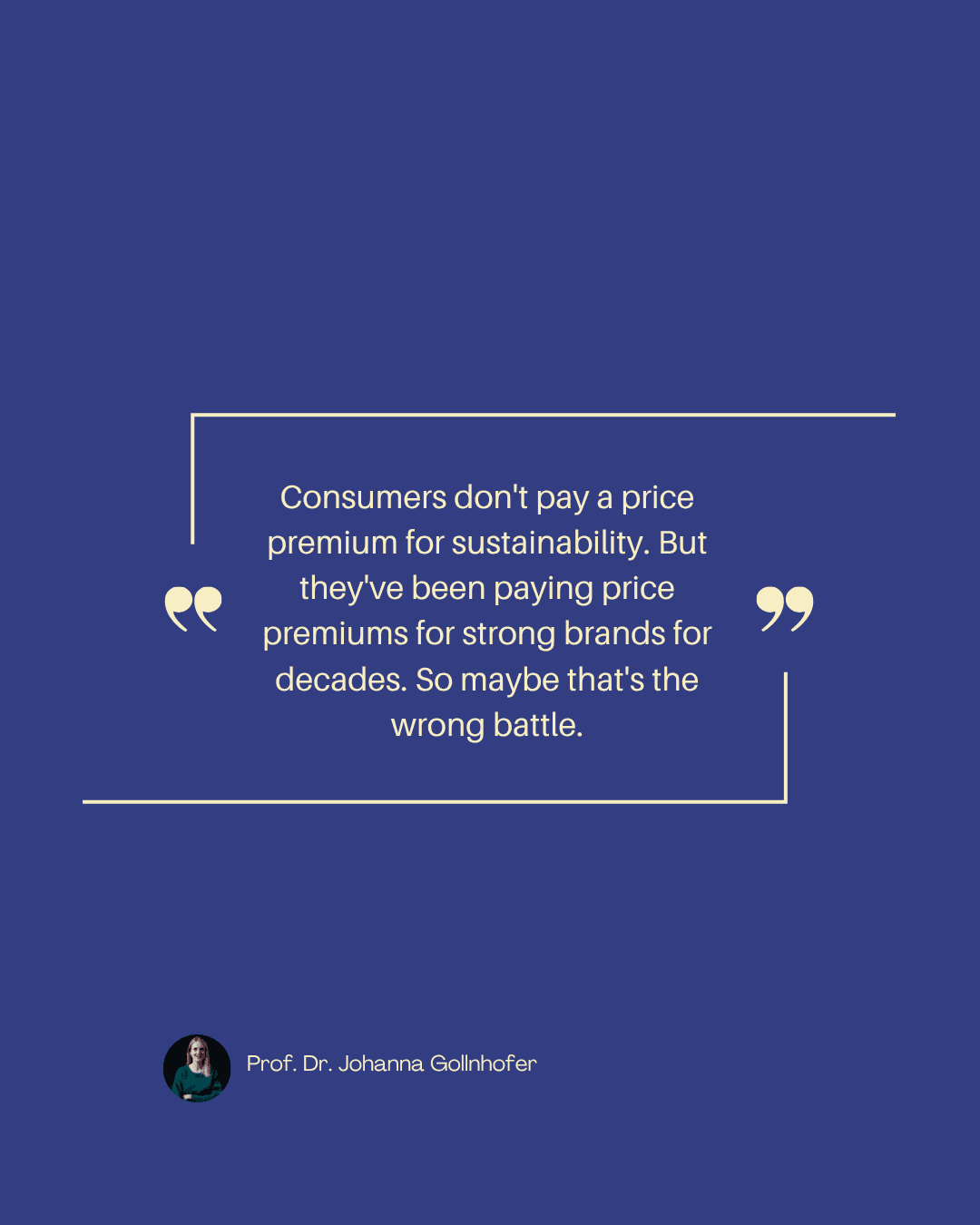
So one of the main challenges, how to conquer the 60% is if you have a sustainable brand, to take your sustainable brand, to transform it into a strong one. into one that evokes emotional connections, into one that is really desirable, into one that does not just play on the eco-image but really reaches people at their heart, at one that is perceived as sexy, attractive, whatever you want to call it. Because in this instance, consumers pay voluntarily more. But they don't pay voluntarily more for sustainability, but for a strong brand. So you have different mechanisms on how you can tackle it. So if I were a politician, I would do it differently. If I work on a brand, I would do it the second way.
This is where it gets really interesting for me because I feel like I've seen this happen so many times. A brand that genuinely means well makes a beautiful, sustainable product and then markets it in a way that only their existing eco-fans would ever click on. Which is like... preaching to the choir and wondering why the church isn't full. You actually have an aim for this, right?
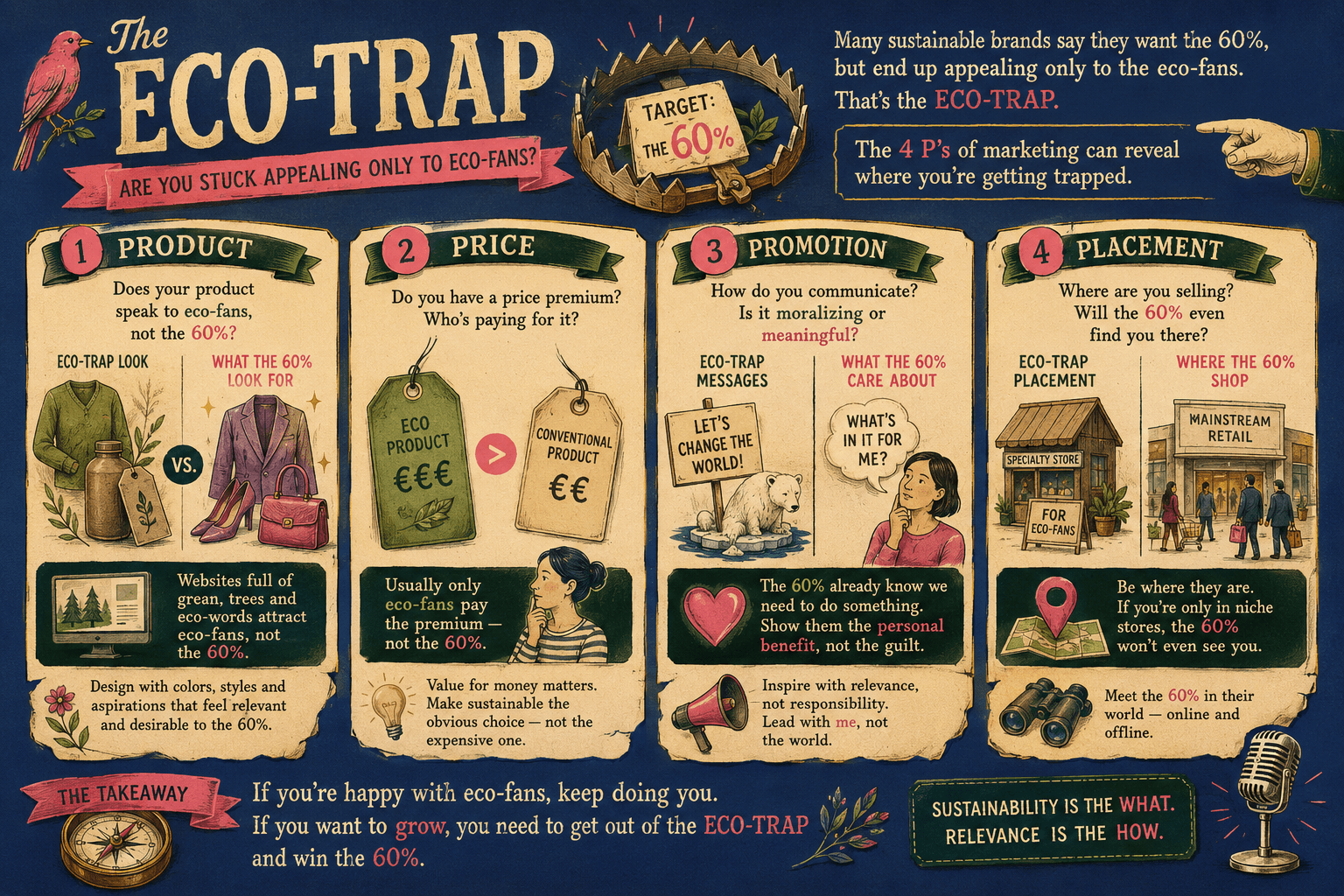
So the eco-trap is also a concept that we developed in our book, The 60% Potential. And we basically analyzed a lot of sustainable brands. And we kind of realized in our analysis that a lot of sustainable brands, they have as target group the eco-fans. And you know, If it's fine for your company just to target the eco-fans, all good. But for most of the companies, the eco-fans, as it is a small segment, is not so attractive. They want to go after the 60%, but over and over again, they just go after the eco-fans. So we call the eco-trap, or the eco-trap is referring to companies that want to target the 60%, but in the end, they only go after the eco-fans. So how do they only go after the eco-fans?
And we can basically break it down into the four P's, which is a core concept in marketing. So the four P's is always product, price, promotion, placement. And if you are in the eco-trap, so this would mean your product looks green, brownish, or blue because it's also often used for the nature. And it has this eco-look. And this eco-look is attractive to the eco-fans but usually not to the 60%. The 60% look for fashionable colors, especially in fashion. And those change every year. Those can be violet. So really look at your product design. Also look at your website, which basically reflects your product. Because if it only comes in green and shows like trees, this is attractive to the eco-fans, not to the 60%. So this is the first peak.
The second P is usually the price. So if your sustainable product costs more than the conventional one, so if you have a price premium on that one, who's paying that price premium? Usually it's only the eco-fans, but not the 60%. So then you can also end up in the eco-trap.
Then you can analyze your promotion. And promotion, so that's the third P, is usually used as a synonym for communication. So how do you advertise your sustainable product? Do you do it in a moralizing way? Do you do it, for instance, let's change the world? And honestly, let's change the world. It's kind of moralizing. And when you think about the average, the mainstream consumer, and they are standing in front of the retail shelf or in a store, they don't even have the mental capacity about changing the world. So if you emphasize that the world is burning, that we need to save the world and they need to change the behavior or that the poor ice bear is melting or it's drowning because the ice he's sitting on is melting. Yeah, this is attractive to the eco-fans, but not to the 60%. The 60% they got or they understood we need to do something. But what comes first is what's in it for me.
And then we can jump to the placement. And the placement is basically the channels through which you sell your product, how you distribute it. And if you're only present in a specialty store, you know, like the eco-fans will find you, the 60% won't even find you there. And it even goes to that point, the 60%, you know, when they enter the classic healthcare stores, like Reformhäuser, it's called in German, that... you have in Germany and also, I think, in Austria, you know, they would never enter that because those are, in their perception, stores for the eco-fans, but not for them. So you need to be there where they are. And this is for us always a tool to really analyze, is there a brand or is there a product that might be stuck in the eco-trap? And just again, as a side note, if you're fine just to have the eco-fans as customers, stick with it. But if you want to grow, if you need to grow, if you want to win over the mainstream consumer, you need to get out of this eco-trap.
When you were explaining that, I had to think about luxury brands in speciality stores to sell their products and only there. And so people would have to go there to buy it, which was a strategy for them, right?
First of all, luxury brands never go after the mainstream consumer. This is just in the nature. Luxury brands play on scarcity. Luxury brands play on not everyone can have it. This is for sure why they are not everywhere. So luxury brands come with a different business model. They go for only a few customers who pay a very, very large price premium. This is how they make money. But I think the whole idea of luxury brands also tells us something differently. What I was mentioning before, we need to have strong emotional brands. And this is exactly what luxury brands are doing. Why do you pay so much for a luxury item? Because the brand is so strong. All of a sudden, you have the money for it. But we cannot expect that we have an average sustainable brand that no one really knows and no one really has an emotional connection to that. There are people who won't pay the price premium. But I think especially the idea of luxury brands, it really highlights the level we have here in marketing. Make your brand so desirable. that people really go for it and that they really want to pay more for it. But for that, you need to invest a lot in marketing. You need to invest a lot in brand building because this doesn't come out of nowhere. You cannot just say, oh my God, my brand is so desirable. Please say that it's so desirable, you know? So it takes a lot of effort and luxury brands, like this is a mechanism that only works for a few brands. Most of the brands are not luxury brands. But I think your point kind of hints where I'm going. But luxury brands operate on different business models.
Of all of your customer insights about the 60%, which one surprised you the most when you found it in the data?
So I told you before, you know, at conferences, like at the Sustainable Conferences around in 2019, I always had the feeling, we are wrong about that. People will not go for so many sustainable products. I always had this feeling, you know, that sustainability as an argument for selling products is not working for the mainstream consumer. But, you know, what really then shocked me when I got deeper into the research, because, you know, there are also other researchers in my field that have been doing studies on that. So I also reviewed their studies. I did my own studies. And then I kind of gained a clearer picture. And, you know, it even got worse.
So it's not just that they did not dislike sustainability, but like what came consistent across all of the studies that is they have really negative associations with sustainability. So when the 60% are hearing the world of sustainability, they don't think, hooray, this is what an eco-fan would think. So if you have listeners that are eco-fans, they would think, no, sustainability is the best thing ever. Mainstream consumers, they think, oh my God, I need to change. I need to sacrifice something. Yes, it's reasonable, but who loves to behave in a reasonable way?
So what became clearer and clearer are those negative associations we have with the word of sustainability. And, you know, there are other words that perform even worse, like vegan. And vegan only comes for vegans with a positive association. The mainstream consumer associates it with no taste at all, unhealthy, something for the margins of society that are a bit of extreme. And, you know, every day I was basically reviewing a new study and then I was really staring at it and was thinking, oh my God, this is really deeply entrenched. And we don't really get it out.
And then what also became quite obvious, just when you think about the world of sustainability, You know, we don't even have a common understanding of it. Like people use it in different ways. Also how this concept developed in business administration. So if you look into older textbooks, they will always talk about sustainable growth. But sustainable growth is not as we both here understand sustainable growth. Sustainable growth in the old textbooks and for still a lot of managers still means long-term growth. So they want to grow long term, but it has nothing to do with the resources of the world. So you have a lot of negative associations. You have a lot of misunderstandings and you have a lot of different definitions flying around. So then it became more and more obvious to me that this was really what was striking me. Like every day it was a new insight that it's deeply entrenched.
And that, yeah, then people always tell me we need to reposition sustainability. But yeah, in the end, what happened to sustainability, it was a differentiating factor. And this is then what you use usually for your marketing because you want to differentiate yourself from competitors. Right now, regulation has been pushing in every company. to a certain extent, does something with sustainability. You know, you can always say, I'm more sustainable than my competitor consumers won't really see it. That's the problem. So what happens with sustainability, it became from a differentiating factor more to a standard. And I agree with you. I think the standard should be higher, but still everyone is doing it. So once it's a standard or when everyone is doing it, you don't need to communicate it. Because you'd market something that usually sets you apart from your competitors. But if consumers doesn't realize the difference, you would not use it in your marketing. So it became more and more obvious for me that like how we market sustainable products also changed in the historical perspective. And yes, that we should market them in a different way.
So it is a good sign that companies are not talking more about sustainability, right?
I would say, like, so it depends. So you always had the thing, people like companies should talk about sustainability, raise awareness. But if you look at the numbers, most consumers here in the German speaking area are aware that it is an issue. So the challenge right now changed, like the awareness was created. And I think there are also other entities out there in the market who are supposed to create this awareness. Just think about NGOs, politicians. So, and as a brand, I think the largest contribution is not to raise awareness, but in the end to produce and to sell more sustainable products. And this is also closely related to a core mission of a company because in the end, usually you sell something. We are still in a capitalist system here. So I think raising awareness was good for a couple of years, but I also believe it's more like it's the key job of other actors and the key job of businesses that want to contribute to sustainable development is to develop sustainable products that are really attractive and to market them in such a way that consumers really want to go for them. And there I see a bigger lever than in raising sustainability because, or the awareness for sustainability, because what we see in our data, you know, the majority of consumers say, yes, we understood it. We have a problem. But then standing in front of the shelf, they are not going for it. And this is what I think businesses need, especially to solve right now.
How do you feel about influencer marketing as a tool for sustainability messaging? Would it help reach the 60% or would it perceived rather like another ad for sustainability?
So it's funny that you're mentioning that. So I have one doctoral student and she's writing her doctoral thesis exactly about sustainable influencers. And, you know, usually marketing, we need to be pragmatic about that. So the first question is always like, who's my target audience? Where do I reach them? What do they want? And if my target audience is to 60% and if they are on TikTok whatsoever, you know, it doesn't really help me to say I'm not going there because if I'm not going there, I'm not reaching them. So in the end, it's also not what do I think of TikTok? Do I personally like it or not? It's about where do I find my target group? And if my target group is there, it can definitely help. But in the end, it all depends on your target group and not your own taste, I would say.
What is one phrase or marketing tactics that you wish brands would just not use anymore when it comes to sustainability messaging?
Yeah, sustainability messaging, sustainable products, just to think. Oh my God, we have something sustainable, vegan, whatsoever, and we make it green. This is like, you know, like the intuitive thing we all go for. And this was necessary when the category of sustainable products was emerging. Because then you went for a green color to signal that you are part, basically, of this category. But you can also see it, especially like for vegan food replacements, you know. Luckily, they moved away from making everything green. You still have a couple of brands, but the others, they go for more fashionable packaging. They go for more fashionable colors because the category emerged. So in the beginning, 10 years ago, 15 years ago, I would say it was the right thing to do. But just because something is sustainable, we don't need to make the whole website sustainable. We don't need to make the product packaging sustainable.
It's also funny. So this is basically how I think you saw the cover of our book. And, you know, it's a book about sustainability. So the publisher house, which is Campus here, they basically send us a draft how we could design the cover. And, you know, they thought it's a sustainable book. And, you know, what was the first cover draft we got? So for sure it was green. Then in the background you could see some trees. And you can see some windmills. And I was like, guys, did you read the content, basically? You know, this is what we are lobbying against. Just because it's like a book about how to market sustainable products, it doesn't need to look like an eco book.
And so... For me, this was attractive. Those were also marketing colors of the year. It looks more like a marketing book. It was also important for me how the book feels, the haptic. So I even touched so many books because we need to make it attractive and also to make it attractive. You know, we have a lot of figures in there and this is intentionally because if we really want to like to win over mainstream readers, mainstream consumers for sustainable consumption, for sustainable products, it's not supposed to look too eco. So even there, they directly thought sustainability, trees and a river, and I was like, no, this is not the content of our book.
Okay, I want to shift gears for a second because I saw something in your research I did not expect. You've also studied decluttering. like the psychology of why we hold onto clothes we never wear. And for me, as someone building an app to help people rediscover what's already in their wardrobe, this felt pretty personal. What actually happens in our brains when we try to let go of something?
I was actually really doing a large project on decluttering for a couple of years. We also published a paper on that in the Journal of Consumer Research, which is one of the leading papers you have, like journals you have worldwide for this kind of research. And it's quite interesting that you also evoke this research because it's also one of the foundations for the book. Because I was collecting data on that. So I was following people into their homes and I saw so much how they were struggling. You know, they were all indicating in surveys, I want to own less. But in the end, they never achieved the classical attitude behavior gap. And this then also reinforced my thinking to really see those extremely clutterers. They are just a minority of our society. But mainstream consumers, they really struggle with it because they love their possessions.
And what is happening, and you can play it with fashion items, it can be furniture and so on, it enters your household. And you usually form an emotional bond. So whether you like it or whether you don't like it, and then you want to get rid of it. And I observed it when people were trying to declutter, you know, they were saying, I didn't wear it for the last few years. I never wore it. But then, you know, the object is kind of talking back to you and saying that maybe I will be in fashion in two years. You should keep me. Or another reason is you paid so much money for me. So I need to be super valuable. So those are really like the psychological mechanisms, how we know that ownership also creates a burden. It's not so easy to get rid of those clothes. And, you know, they kind of form this emotional attachment.
And then consumers try to break up this emotional attachment. And you know what they often do? They put it, for instance, in cooling down boxes. So they put it in boxes, they place their clothes there, and then they don't touch it for three months. And this is basically to break the emotional linkage you have with the object. And then often they don't even look into there any longer and just say, okay, right now you go. So extreme you need to get because they kind of have this emotional bond.
Now, you definitely see those business models like the refurb business models. Let's just think about like it can also be fashion, but it can also be electronic devices. So that they make it as easy for you as they can. Because, you know, you feel better if you have the feeling that your fashion item or your electronic device finds a second home. But I also know from my studies, there's one big problem. Like you always overestimate how much your item, how much your electronic device is worth. So you think because you have this emotional attachment, this bag or this old smartphone still needs to be worth 100 euros. But then the refurb partner will tell you, sorry, I give you 20 for that. And this is what we see over and over again. But this is also explained because you have this emotional connection and then the market tells you no. Sorry, it's only 20. And then for sure you feel deceived. But in the end, those models, like refurb, stuff like that, they make it easier for you at least to get them out because you don't want to just throw them. This is then what would give you a bad feeling. At least you want to have a good feeling that you don't throw it.
But I know from my studies... One of the main obstacles is because people are convinced that their stuff is far more worth than what the marketplace then is paying for it. Also, if you study people who declutter, some of them do it for sustainable reasons. So some of them do it for totally practical reasons. And this is also what I learned in my studies. Most people who declutter, the main reason is not sustainability. The main reason is, it's again the question, what's in it for me? The main reason is they want to feel less burden at their homes. They want to have less decluttered homes. You know, it's not that they are saying, oh my God, I want to declutter and then I want to buy less because I'm a sustainable person. This is what an eco-fan would say. The 60% would say, oh my God, I want to have a cleaner and neater home, you know, so that you get the Instagram, TikTok aesthetics in there. And yes, then I will buy less or in future I will buy fewer items. This then is more sustainable, but this is often not the main reason. And this is also where we can really see that sustainability is the main driver only for a minority of people. For the rest, it can be there, but usually it's not the main purchasing or decision driver.
Fortunately,
I would wish for it. And we also hope for it. We've been talking about the green sustainable segment, however you would call it. So we call it the eco-fans. You could also call it the green segment, the sustainable segment. And we were hoping that this segment is growing. And we checked for that since the 80s. Unfortunately, it's not really growing. It's still the minority. So we cannot make more of the 60% and we cannot turn them into eco-fans. This won't happen. Because for an eco-fan, you really need to put basically sustainability first and it's super, super tricky. So the thing is that we say, okay, we need to make it for the 60% as attractive, as sexy, as easy, as possible to really go for them for sustainable products because we won't turn them into eco-fans.
But here again, we really see like it also would be more sustainable like not to buy so many stuff. Because most households own everything. I don't know how many t-shirts you own, but I'm quite sure in principle, you don't need to buy any t-shirt for the next five years. You have enough. I have enough as well. So why do we always buy more t-shirts, more jeans and so on? This is a classical consumerist society and consumerist society basically goes in the direction, new stuff, more possessions will even make you happier. This is, you know, the whole consumerist society. And we've been socialized with that. We've been brought up with that. For sure, this runs against the idea of consuming less.
You know, listening to all of this, I have to be honest. A lot of it is landing very close to home. Because I'm building a fashion app. And I started with fashion. and being trendy and looking great and then went into sustainability. So sustainability then became the DNA of the whole thing, which made me question how to handle all of it. Somewhere along the way, I started to feel like I was talking to the 50% who already agreed with me. And losing everyone else I had before when I was talking about fashion. Can I put you on the spot for a second? Would you reposition a startup like that? And how?
Congratulations on your startup. That's amazing. So what really makes your brand special? And right now, when you answer this question, don't mention it's sustainable. It has a circular business model whatsoever. What is special about your product or about your app or whatsoever? What does it solve for the customer here?
It helps people to self-express more basically through their clothes.
So this would be, I would assume, like this would be an argument that clicks with the 60%. Like because self-expression through clothes is always one point. Also what I got, you have an app note. So an app, so what is really the pain point you're solving for them? So, and just coming right now from my own experience, the pain point of a lot of females here in this area is we own a lot of clothes. We don't even what we own because it's hidden far down in the closet. We don't even know what is matching. So, and then in the morning you're standing in front of your closet and you have the feeling you have nothing to wear. In the end, you have a lot, but you just have the feeling. So I would really figure it out. What is this feeling here for your target group?
And you know, also what I was telling you, it was not about sustainability or whatsoever. Really, the first question is always, you need to understand your target group. What is really the pain point? And then, because only if you understood this, you can make it so attractive that they cannot resist. Because I would assume your app costs something that a lot of people could still afford. So it's not a question that they cannot afford it. It's a question, do they want to afford it? And do they want to afford it? Really dive deep into your target group. What really makes it click for them? What is the pain point you're solving? And that pain point is not sustainability in most cases. So what are you really solving for them? And if you do not fix a pain point, then I think you need to reconfigure a little bit more on the product app side.
Is there a risk of having the sustainability gene as a startup from day one?
So the thing is, we need to have sustainable businesses. The question is, like, but it can be that you're really sustainable, but then the question is always, do you market it? You know, you can set up all of the sustainable processes in place, but you do not need to mention it in your advertisement. So it depends entirely, again, on your target group if you should mention it or not.
So I think it's a super nice approach, especially also what you are pursuing. You build a sustainable startup. So you try to do everything as sustainable as you can. And I think this is really great. But then the question is, which target audience do you want to reach? So you can for sure say, okay, I first want to grow within the eco-fans. Then I would put more like those sustainable labels and sustainable initiatives, what you do on like in the forefront, because this is quite attractive for them. So you can definitely always go first for the eco-fans. And then you can try like after a couple of years, once you won over the eco-fans to switch over to the mainstream consumer. This is then when I would change my marketing, my communication. But this doesn't mean that I would change the underlying business model, you know? Just because you change your marketing doesn't mean you need to give up everything what you've been doing in terms of sustainability. It's just, what do you communicate? What do you market? Or you could say from the beginning, hey, I do a sustainable startup. I do everything. But as my target group are the 60%, I don't waste any marketing budget on that. Because I know for the 60%, the sustainable, it's a nice side argument, but it's not the main purchasing driver, so I focus on the main purchasing driver. So it all depends in the end, and it's a strategic decision, you know, which segment you go over. It's a strategic decision, and strategy always means you pick one segment, but you also say no to another segment. So it's basically two ways, but you can go for either of them.
Okay, that's interesting, thank you so much for sharing that. What gives you hope that these 60 percent will actually shift in the next five years? What would that shift even look like in everyday life?
Like what I would aspire to, you know, for me, it's not about answering the question, do you want to shop more sustainable? But I want to see the effect in the sales numbers. So I also want the companies to see the effect in the sales numbers. So this would be for me the aspiration to sell more sustainable products. Not that 2% more are getting aware of the climate change. We are already at such a high number. to sell the numbers, like to sell more ecological, sustainable products instead of conventional ones. You know, this is the main lever for me that I have in marketing. If I were like a professor for supply chain, for sure, I would have a different goal. If I were a politician, I would also have a different goal and I would also be able to do different measures.
So for me, in order to sell more sustainable products, I think, and I see a lot of examples where I would say they are on a really interesting and good way. You know, we already moved away a little bit from the advertisements where you had a burning earth. You know, in a burning earth, honestly, we know that negative images in marketing do not work. And we know that since 40 to 50 years. You know, they raise awareness, but they don't convert the people. So I see a lot of positive developments here. So first on how... people basically or how managers market sustainable products. Also with regulations, you know, you always have a little bit of backlash, but it's going slowly one step ahead of the others.
And I think what we always forget a bit right now, currently everything is about AI. You know, like four years ago, you had two main topics in business. I would say it was AI and it was sustainability. Right now, everything is about artificial intelligence. So you could draw the conclusion that sustainability is over. But I think this is the wrong conclusion. Just the changes that we are seeing, like all the changes that are happening, they are not so much in the foreground any longer. And also just out of necessity, you know, we cannot just stop. We cannot just say we stop right now with sustainability. It's so essential. You know who can stop right now with sustainability? are sustainability experts on LinkedIn. Right now, they are all AI experts because they just go with the trend, you know, in the end. But there, for me, there's a lot of hope. I see a lot of changes. They are not so prominent because right now the whole discourse is submerged under AI. But it's slow changes. But I would say it's changes. And so I'm quite an optimist that step by step,
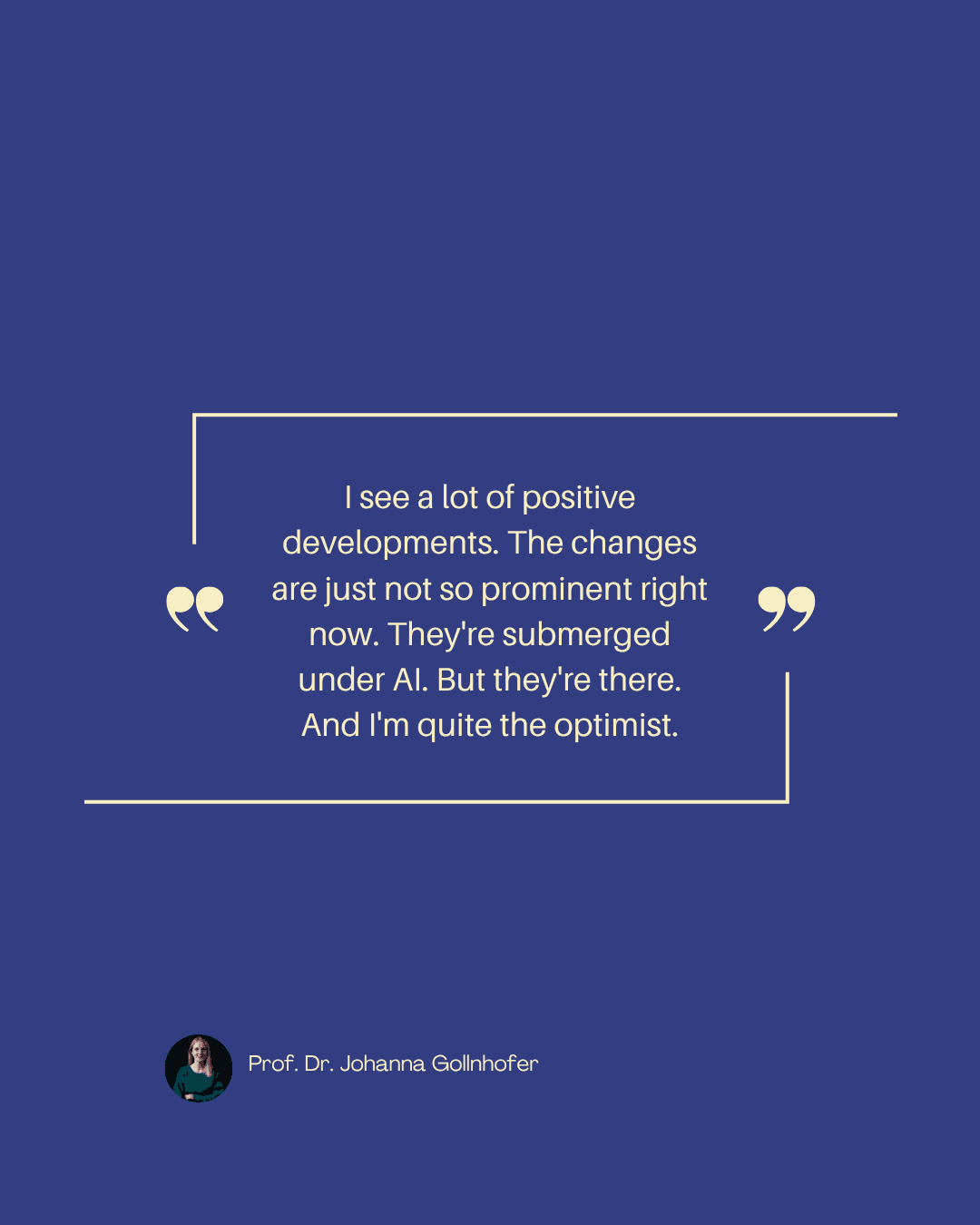
we will go further for sure. I would wish it to be faster like as everyone did, but I think sometimes we really, if you read the newspaper you could think, oh my god, we went 300 steps back. If then you really look into the numbers, this is also not true.
Thank you so much. Can I ask you, um, to share if there's anything you also wanted to share on the podcast, to get it out of you. Or also tell the people about your book. I will also link the book in the description notes of the podcast and your connections. So just final words, basically.
So, you know, what was a little bit surprising, like what I only discovered once the book was out. So it was mainly written like for like a B2C context, like fashion, FMCG content. But the framework applies to almost every industry. I have some weeks where I present it to automotive. I have some weeks, the other week, then it's FMCG. The other week, it's organic products. The other week, it's a B2B setting. I even had it in a medical setting. And I think it's a really customer-centric tool in the end because we need sustainable products. But what we should never forget for sustainable products, we need customers to buy it. And it's never a good idea to come from your product. You always need to come from the customer. And this was the key or main takeaway that I realized then when I was presenting it to so many industries. So in the end, it's really focusing on the customer and not so much on the sustainable product.
That last part about focusing on the pain point first and sustainability second is something I'm genuinely going to sit with for a while. Because I think a lot of us who... care deeply about the planet, make the mistake of leading with the cause instead of the connection. And Johanna made me realize that doesn't make you a bad activist. It just makes you a bad marketer. And you can fix that. Her book is called The 60% Potential. And I will link it in the show notes. Whether you are building a brand or working in marketing, or just trying to understand why sustainable products still feel like they are talking to someone else. I would genuinely recommend it.
If something in this episode made you stop and think, good, that's the whole point. Curious by Design is about finding the story behind the obvious one. And fashion? It's got layers, literally and figuratively. Every episode this season pulls on a different thread. I promise you, it unravels fast. You'll find links, sources and more in the show notes. And if you like this, share it with one other person who would never expect to find themselves genuinely grouped by a conversation about clothing. Those are my favorite listeners. Stay curious and I'll see you next time.